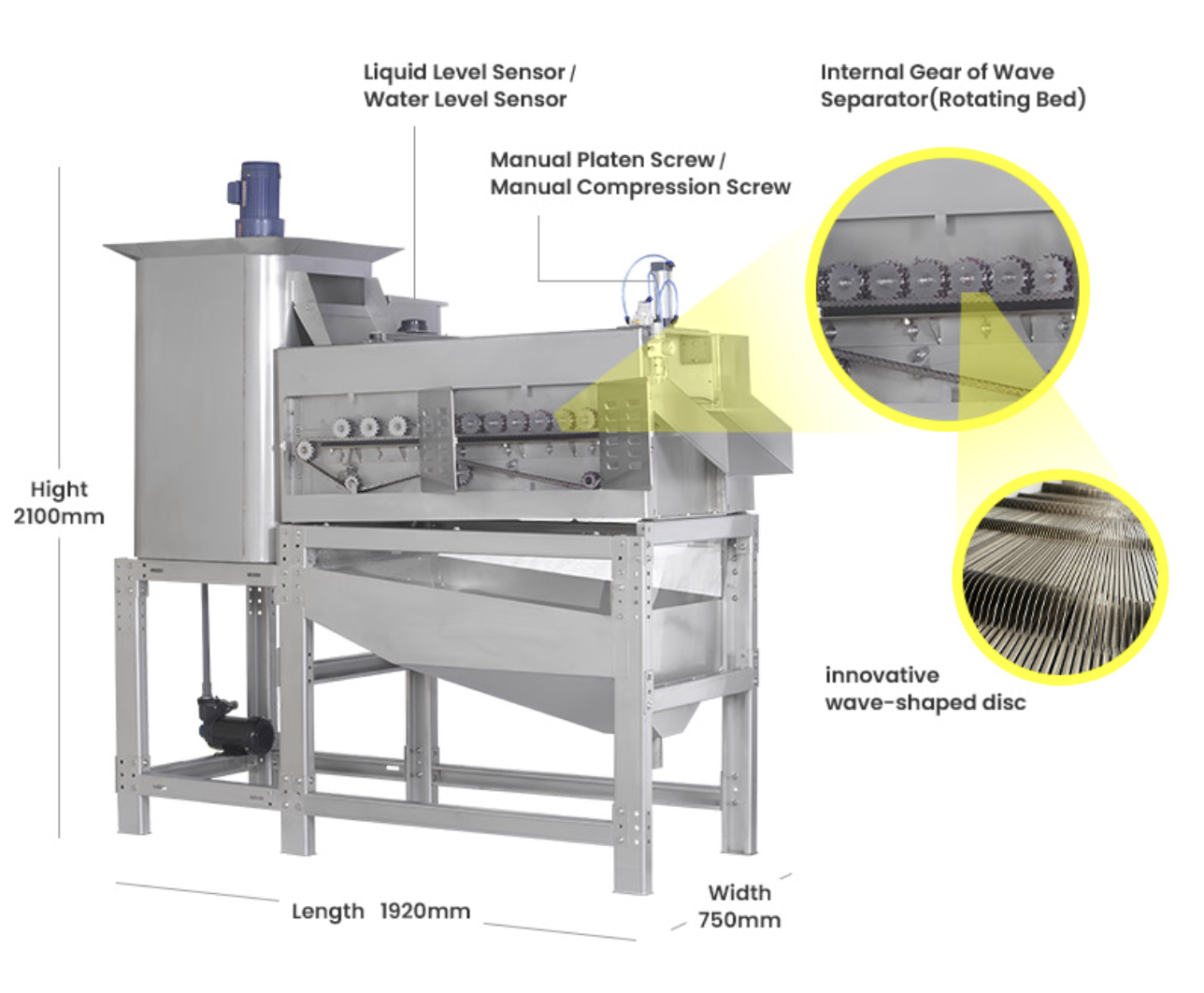
A sludge dewatering machine is mechanical equipment that separates water from sludge to reduce its volume and weight before disposal or reuse. Choosing one is not a question of which machine is best in general — every mainstream technology works well on the sludge it was designed for and fails predictably on sludge it was not. The decision starts with your sludge, not with the equipment catalog.
That inversion is the reason so many dewatering rooms contain an expensive machine that nobody wants to talk about. A belt filter press is an excellent thickener for municipal biological sludge and a poor choice for fibrous textile sludge. A decanter centrifuge produces a dry cake and consumes a great deal of power to do it. A plate and frame press achieves high cake solids in exchange for batch operation and manual handling. None of those statements is a criticism of the technology. They are specifications.
This guide walks through the five families of sludge dewatering machine in commercial use, the sludge properties that select for and against each one, the cost drivers that separate purchase price from five-year cost, and the data you need in hand before requesting a quote from any supplier.
What does a sludge dewatering machine actually do?
A sludge dewatering machine removes free and interstitial water from sludge so that a large volume of liquid waste becomes a much smaller volume of handleable solid. Sludge from wastewater treatment commonly arrives at the dewatering step containing only a few percent solids by weight; municipal biological sludge in particular can be over 99% water before treatment. Mechanical dewatering typically raises solids content to somewhere in the range of 20% to 40%, depending on sludge type and technology.
The economics follow directly from arithmetic that is worth doing once, because it explains why dewatering pays for itself in a way that few other treatment steps do.
Take one metric ton of sludge at 2% dry solids. It contains 20 kg of actual solids and 980 kg of water. Dewater it to 20% dry solids and those same 20 kg of solids now sit in 100 kg of cake. You have not destroyed anything — you have simply stopped paying to haul 900 kg of water. That is a tenfold reduction in disposal tonnage from a single unit process.
Disposal cost is also moving in one direction. The Environmental Research & Education Foundation reported a national average U.S. landfill tipping fee of $62.28 per ton in its 2024 analysis, a 10% increase year over year and the largest single-year jump since 2022. Every percentage point of moisture you leave in the cake is tonnage you pay for again at the gate, every week, for the life of the plant.
What are the main types of sludge dewatering machine?
Five families cover almost all commercial installations. Each is defined by the physical force it uses to separate water from solids, and that force determines both its strengths and its failure mode.
Belt filter press
Sludge is conditioned with polymer, distributed onto a moving porous belt, drained by gravity, and then squeezed between two converging belts through a series of rollers. Belt presses handle high throughput continuously and are mechanically straightforward, which is why they remain common in municipal plants.
The dependency to understand is wash water. Belt permeability must be restored continuously by high-pressure spray, so a belt press needs a wash water supply, a wash pump, and nozzles that require attention. That wash water also returns to the head of the plant as recycle load. The characteristic failure mode is belt blinding, and fibrous or oily sludge accelerates it.
Screw press and multi-disc screw press
A slowly rotating screw — typically around five revolutions per minute — conveys sludge along the inside of a cylindrical wedge-wire screen, with the volume between flights decreasing to build pressure. Screens generally have apertures below half a millimeter, and because the screen resists clogging better than filter cloth, spray cleaning is applied only intermittently, on the order of a few percent of operating time.
Screw presses are quiet, slow, low-energy, and well suited to municipal waste activated sludge. Their weakness is material that wraps or films: long fibers wind around the shaft, and heavy oil and grease coat the screen in a way intermittent spraying does not clear.
Plate and frame filter press
A batch technology. Sludge is pumped into a stack of chambers formed by filter cloths under high pressure, water passes through the cloth, and the cake is released when the stack opens. Plate and frame presses reliably deliver the highest cake solids of any common technology, which is why they persist in mineral processing and metal finishing.
The trade-offs are structural rather than incidental: batch cycles rather than continuous flow, a large footprint, cloth replacement as a recurring consumable, and manual attention at cake discharge. For a plant with continuous sludge production and limited staffing, those trade-offs are significant.
Decanter centrifuge
A horizontal bowl spins at high speed and a scroll conveyor moves settled solids toward the discharge. Centrifuges are compact relative to their capacity, tolerant of abrasive and variable feed, and capable of a dry cake without wash water.
They also carry the highest energy demand in the category by a wide margin, produce substantial noise, and depend on precision components. For buyers outside the manufacturer's home service network, the practical question is not whether a centrifuge works but how long a bearing or scroll repair takes and where the technician flies in from.
Wave disc separator
A stack of wave-profile discs rotates slowly around a central shaft, pushing slurry toward a screen surface where liquid passes through wedge-shaped gaps while solids are dewatered between the discs and discharged as cake. The geometry is continuously self-clearing, which is the design response to blinding rather than a wash-water response to it.
This family is the newest of the five in commercial use and is aimed specifically at organic sludge that defeats screen-based equipment — oily streams, fibrous streams, and high-moisture biological sludge. Its boundary condition is abrasive and metal-bearing material, which it is not designed to process.
| Criterion | Wave disc | Screw press | Belt filter press | Plate and frame | Decanter centrifuge |
| Operation | Continuous | Continuous | Continuous | Batch | Continuous |
| Clogging risk | Low | High | High | High | Low |
| Wash water | Not required | Occasional | Frequent | Regular | Not required |
| Oily sludge | Suitable | Depends on oil load | Poor | Poor | Poor |
| Footprint | Small | Medium | Large | Large | Large |
| Power demand | Low | Medium | Medium | Medium | Very high |
| Noise | Low | Medium | High | High | Very high |
| Maintenance | Easy | Difficult | Limited | Limited | Often needs overseas service |
| Operating complexity | Easy | Difficult | Difficult | Difficult | Difficult |
Which sludge properties actually decide the choice?
This is the section most equipment pages skip, because it requires saying where a technology does not belong. Six sludge properties determine the shortlist, and in practice two or three of them will eliminate most of the field before price is ever discussed.
- Feed solids concentration. Every machine has a design window. Feed that is too dilute wastes throughput on water; feed that is too thick stops being pumpable. Confirm the window before anything else, and measure your feed across a full production cycle rather than at one moment.
- Oil and grease content. Fats and oils form a film on filter media that spray cleaning does not fully remove. High FOG loads disqualify belt and cloth-based equipment far more often than buyers expect.
- Fiber content. Long fibers bridge across screen openings and wrap rotating shafts. Fiber is the single most common cause of the gap between a machine's rated capacity and its actual capacity.
- Grit, sand, and metal particles. Abrasives wear screens, discs, and scrolls. They favor centrifuges and plate presses and rule out equipment built for organic sludge, unless grit removal is installed upstream.
- Variability. A plant with batch dumping and swinging pH stresses equipment differently from one with a steady equalized feed. Specify against the range, not the average.
- Staffing model. A batch press in an unstaffed night shift is not a batch press — it is a machine that stops. Match the operating pattern to the people who will actually be present.
| If your sludge is... | Strong candidates | Usually the wrong choice | Why |
| High oil and grease (food, rendering, grease trap) | Wave disc | Belt press, plate and frame | Oil films the filter media and spray washing cannot restore permeability |
| Fibrous (textile, carpet, pulp and paper) | Wave disc | Screw press, belt press | Fiber bridges screen openings and wraps the screw shaft |
| High-moisture organic (livestock, brewery, DAF float) | Wave disc, screw press | Plate and frame | Continuous operation matters more than maximum cake dryness |
| Abrasive or grit-laden (wool scour, beamhouse) | Centrifuge, plate and frame | Wave disc | Abrasives wear precision separation surfaces |
| Metal-bearing (plating, chrome tanyard) | Plate and frame, centrifuge | Wave disc, screw press | Metal particles fall outside organic-sludge design envelopes |
| Municipal biological sludge, staffed plant | Belt press, screw press, centrifuge | — | Well-established technologies with a long service base |
| Maximum cake dryness is the priority | Plate and frame, centrifuge | — | Highest achievable solids, accepted alongside batch operation or high power |
Read that table as a shortlist generator, not a verdict. Two candidates surviving your sludge profile is a good outcome; the choice between them is then made on cost, footprint, and service.
What does a sludge dewatering machine cost to run?
Purchase price is the smallest number in a dewatering decision and the only one most quotations contain. Six recurring costs decide the five-year total, and they differ far more between technologies than the capital figure does.
- Connected power. Compare nameplate horsepower across the whole skid, not just the main drive — wash pumps, air compressors, and polymer systems all draw. Multiply by annual run hours and your industrial electricity rate.
- Wash water. Where wash water is required, count the water cost, the sewer charge, and the hydraulic recycle load returned to the head of the plant. In a capacity-constrained plant, the recycle load is worth more than the water bill.
- Consumables. Belts, filter cloths, screen baskets, doctor blades, and spray nozzles are recurring. Ask specifically what wears, how often, and what it costs — a low capital price with an aggressive consumable schedule is a financing structure, not a saving.
- Polymer. Usually similar across technologies for the same sludge, since demand is driven by sludge chemistry. Include it, but do not expect it to differentiate.
- Labor and downtime. Convert hours lost to clearing, unblinding, and cake handling into production value, not just maintenance wages. This is where the gap between technologies is widest and where it is least often measured.
- Service reach and spare parts lead time. For imported equipment, ask where spares ship from and what the typical lead time is. A two-week wait for a part is a two-week sludge storage problem.
A practical test for any supplier: ask them to quote the five-year consumable and service cost alongside the machine. A manufacturer confident in a low-consumable design will answer immediately. The reluctance itself is information.
How does the Wave Separator sludge dewatering machine work?
The GreenCarry Wave Separator is a sludge dewatering machine built on a wave-shaped disc design for continuous solid-liquid separation. The discs rotate slowly along a central axis, pushing slurry toward the separation screen surface; liquid passes through wedge-shaped filter gaps while solids are dewatered between the discs and discharged as concentrated cake. The continuous self-cleaning action is what allows it to run on oily and fibrous sludge without wash water.
GreenCarry Technology Co., Ltd. is a Taiwan-based manufacturer of sludge dewatering and aeration equipment, serving livestock, food and beverage, textile and tannery, pulp and paper, chemical, distillery, and municipal DAF applications. Two models are offered, differing in throughput rather than mechanism.
| Model | Dimensions (L × W × H) | Weight | Power | Voltage (50/60 Hz) | Raw sludge input | Dewatered output |
| GC-500 | 1,920 × 750 × 2,100 mm | 570 kg | 2 HP | 220V / 380V / 440V, 3-phase | 200–300 kg/hr | 40–60 kg/hr |
| GC-800 | 2,300 × 1,100 × 2,100 mm | 760 kg | 2 HP | 220V / 380V / 440V, 3-phase | 400–600 kg/hr | 80–120 kg/hr |
Throughput figures vary with sludge characteristics, and the optimal feed range is 2% to 7% solids content. A flocculant mixing tank and automated control system are available as options, along with disc configurations matched to specific sludge types and site conditions. Because both models operate at 2 HP, the electrical infrastructure required for the dewatering room is modest, and the compact footprint suits retrofits into existing treatment buildings.
Where the Wave Separator is not the right machine
The Wave Separator is designed for organic sludge and is not suited to streams carrying significant sand, grit, or metal particles. Wool scouring, tannery beamhouse flows, and root-vegetable washing lines need grit removal upstream. Chrome-precipitation sludge and metal-bearing plating sludge fall outside the design envelope entirely and belong on plate and frame or centrifuge equipment. Any supplier claiming a single machine handles every sludge stream in a plant is describing a sales position rather than an engineering one.
What information do you need before requesting a quote?
Suppliers can only size equipment as well as the data allows. Gathering these seven items before you contact anyone shortens the quotation cycle from weeks to days and makes competing quotes genuinely comparable.
- Daily sludge volume, expressed as cubic meters or kilograms per day, and whether production is continuous or batched.
- Feed solids concentration as a percentage, measured across a full production cycle rather than at a single sampling point.
- Sludge origin and composition: biological, chemical, DAF float, or a blend, with an estimate of oil, fiber, and grit content.
- pH range and temperature of the stream that will actually reach the machine.
- Current equipment and its specific failure mode, if you are replacing something — clogging, downtime frequency, cake quality, or labor demand.
- Available floor space, ceiling height, and plant voltage and frequency.
- Current disposal cost per ton and monthly hauled tonnage, which allows any competent supplier to build the cost case alongside the technical recommendation.
Frequently asked questions
What is a sludge dewatering machine used for?
A sludge dewatering machine reduces the water content of sludge produced by municipal or industrial wastewater treatment, converting a large volume of liquid waste into a much smaller volume of solid cake. The purpose is to cut disposal tonnage and hauling cost, reduce odor and handling problems, and prepare the solids for landfill, incineration, composting, or resource recovery.
Which sludge dewatering machine gives the driest cake?
Plate and frame filter presses generally achieve the highest cake solids, with decanter centrifuges close behind. Both trade something for it — the plate and frame press operates in batches and requires manual attention at discharge, while the centrifuge consumes considerably more power than any other option. If continuous unattended operation matters more than the last few percentage points of dryness, a continuous technology is usually the better economic choice.
What feed concentration does the Wave Separator require?
The optimal feed range is 2% to 7% solids content. Thickened waste activated sludge, DAF float, and clarifier underflow commonly fall inside that window. Feed that is more dilute reduces effective throughput, and feed that is substantially thicker becomes difficult to pump consistently, so a thickening or equalization step upstream is worth confirming during design.
Can a sludge dewatering machine handle oily sludge?
It depends entirely on the technology. Oil and grease form a film on filter cloth and belts that spray washing does not fully remove, which is why belt presses and plate and frame presses struggle with high-FOG streams. The Wave Separator's continuous self-cleaning disc action is specifically designed to process oily and fibrous sludge, making it a common choice for food processing, rendering, and grease trap applications.
How much space and power does the equipment need?
The GC-500 measures 1,920 × 750 × 2,100 mm and weighs 570 kg; the GC-800 measures 2,300 × 1,100 × 2,100 mm and weighs 760 kg. Both operate at 2 HP on three-phase power at 220V, 380V, or 440V, 50 or 60 Hz. No process wash water line is required. Share your bay dimensions and plant voltage with the engineering team for a fit check before finalizing layout.
What maintenance does a wave disc machine require?
Routine upkeep consists of a clean-water rinse during weekly downtime or scheduled production gaps, with bearings as the primary consumable, replaced on an interval determined by the pH and temperature of the sludge. There are no belts, filter cloths, or spray nozzles in the wear path, which is the main structural difference in the maintenance budget compared with belt press equipment.
Start with your sludge, not with the catalog
Every technology in this guide is the right answer somewhere. The mistake that costs plants the most is selecting on rated capacity and purchase price, then discovering that the sludge on site behaves nothing like the sludge the machine was designed around. Characterize the feed first, use it to eliminate the technologies that cannot work, and only then compare the survivors on five-year cost.
Talk to GreenCarry's engineering team about your application. Send your daily sludge volume, feed solids percentage, sludge origin, pH range, and current disposal cost, and you will receive a model recommendation, a technical fit assessment, and a direct answer if the Wave Separator is not the right machine for your stream.
- Sludge Dewatering Machine — Wave Separator specifications: greencarrytech.com/en/p101-sludge-dewatering-machine-wave-separator
- Spherical Aeration Diffuser: greencarrytech.com/en/p102-spherical-aeration-diffuser
- Industry applications: greencarrytech.com/en/application
- Request a quotation: greencarrytech.com/en/contact
GreenCarry Technology Co., Ltd. — Innovating Technology, Protecting Our Planet.
Food Processing Wastewater Treatment: Stop Grease Clogging and Cut Sludge Disposal Costs