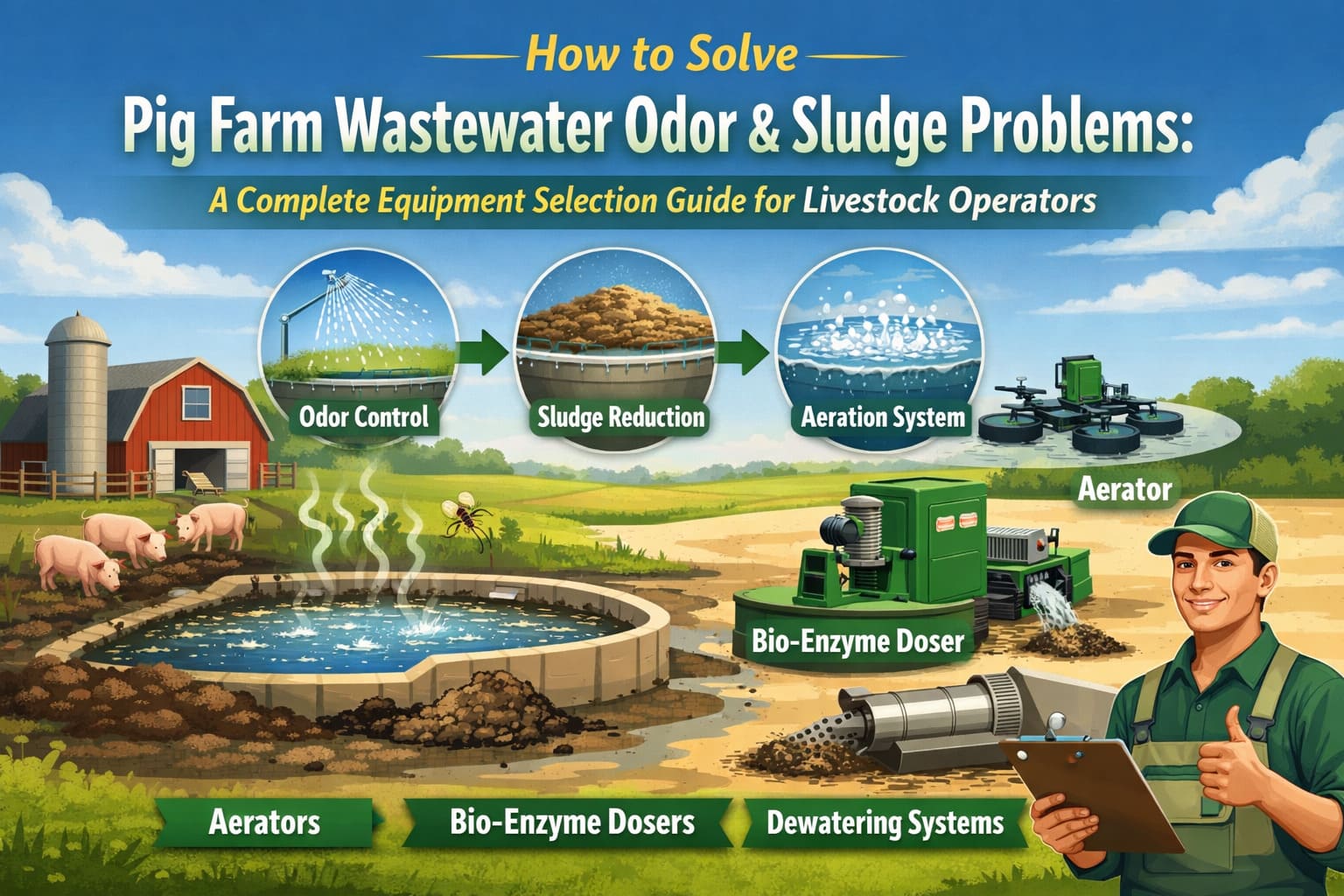
Why Livestock Wastewater Is the Hardest Industrial Effluent to Treat
Most industrial wastewater arrives at a treatment plant with relatively predictable composition — the upstream process is controlled, the chemistry is documented, and the flow rate is regulated. Livestock waste is none of these things.
High organic load and moisture content
Pig manure slurry typically contains 90–95% water by weight. A single 100 kg finisher pig produces approximately 6–8 litres of liquid manure per day. Scale that to a 1,000-head farm and you are managing 6,000–8,000 litres of slurry daily — seven days a week, every week of the year. The organic fraction — comprising undigested feed, ammonia compounds, and microbial biomass — makes this waste highly susceptible to anaerobic decomposition if not processed promptly.
Odor as a compliance and community risk
Hydrogen sulphide (H₂S), ammonia (NH₃), and volatile fatty acids are the primary odor compounds generated during manure decomposition. In many jurisdictions, odor complaints from neighbouring properties now carry the same legal weight as water quality violations. Farms that fail to manage slurry promptly face not just regulatory fines but civil nuisance claims — a risk that has increased significantly as residential development expands into formerly rural areas.
Regulatory pressure is tightening globally
The EU Nitrates Directive, Taiwan's Livestock Manure Management Act, and equivalent frameworks across Southeast Asia and South America are moving in the same direction: stricter effluent discharge limits, mandatory treatment records, and in some regions, mandatory biogas recovery for farms above a certain herd threshold. Equipment that was compliant three years ago may not meet next year's standards.
Why Traditional Dewatering Methods Fail on Farms
Before evaluating newer technology, it is worth understanding precisely where conventional equipment breaks down — because the failure modes explain why so many farms are still running inefficient systems they inherited rather than upgrading.
Screw press: effective until it meets fat
Screw press (auger) dewatering machines work well on relatively homogeneous, low-fat biosolids. Livestock slurry, however, contains a significant proportion of undigested fat and oils from feed. Fat accumulates on the auger flights and within the screen basket, gradually restricting flow. The machine continues to run but throughput drops, pressure builds, and within weeks the screen requires manual cleaning — a labour-intensive task that most farm operators cannot sustain consistently.
Belt press: high water consumption, high maintenance
Belt press systems can achieve good solid-liquid separation but require continuous high-pressure wash water to keep the filter belts clean. On a medium-sized pig farm, this can add 50–100 litres of clean water consumption per hour of operation. Belt replacement is also a recurring expense, with typical service life of 12–18 months under livestock slurry conditions.
Centrifuge: high capital, high operating cost
Centrifuges deliver consistent performance but are capital-intensive, energy-hungry (typically 15–30 kW), and require skilled maintenance. They are economically viable for large municipal plants processing millions of litres per day — not for a 500-head pig farm running 6,000 litres of slurry.
The pattern across all three technologies is the same: they were engineered for conditions that do not match livestock waste. The solution is not to run conventional equipment harder — it is to use equipment designed specifically for high-moisture, high-fat organic slurry.
How the Wave Separator Works — and Why the Design Matters
The GreenCarry Wave Separator uses a slow-rotating stack of wave-profile discs with precision slit gaps. The slurry enters the feed zone, liquid passes through the slits under gravity and slight positive pressure, and the solid fraction is conveyed forward to the discharge outlet.
The self-cleaning mechanism
A set of internal blades moves in a cyclic pattern between the disc faces, continuously dislodging any solid material that begins to accumulate in the slit gaps. This happens automatically, without stopping the machine, and without operator intervention.
In practical terms: operators who previously spent 2–4 hours per week manually cleaning a screw press screen have reduced that time to approximately 15 minutes of light rinsing.
Energy consumption: the 2 HP reality
The Wave Separator runs at full processing capacity on a maximum of 2 HP (approximately 1.5 kW). A comparable screw press on the same throughput typically draws 3–5 kW, and a centrifuge handling similar volumes would consume 15–22 kW. Over a 12-month operating period (8 hours/day, 300 days), the energy saving against a centrifuge alone amounts to approximately 32,400–49,200 kWh — at a USD 0.12/kWh industrial rate, that represents USD 3,900–5,900 in avoided electricity cost annually.
Zero wash water operation
Unlike belt press systems, the Wave Separator requires no continuous wash water during operation. A brief rinse at the end of each operating cycle — approximately 5 minutes with clean water — is sufficient for maintenance. For a farm processing 8 hours daily, this reduces wash water consumption by over 90% compared to belt press alternatives.
Equipment Selection by Herd Size: GC-500 vs GC-800
This is the section that most equipment suppliers omit entirely. Rather than publishing a single throughput number and leaving operators to calculate the rest, the table below maps typical herd sizes to daily slurry volumes, required processing capacity, and recommended model.
Table 1 — Herd Size to Model Selection Guide
| Herd Size | Daily Slurry Volume | Recommended Model | Daily Operating Time |
|---|---|---|---|
| 50–200 pigs | 300–1,600 L/day | GC-500 | 2–4 hours/day |
| 200–500 pigs | 1,600–4,000 L/day | GC-500 | 4–8 hours/day |
| 500–1,000 pigs | 4,000–8,000 L/day | GC-800 | 4–6 hours/day |
| 1,000–2,000 pigs | 8,000–16,000 L/day | GC-800 ×2 | 6–8 hours/day |
| Cattle (50–200 head) | 2,500–10,000 L/day | GC-800 | 4–8 hours/day |
| Poultry (5,000–20,000 birds) | 1,000–4,000 L/day* | GC-500 | 3–6 hours/day |
* Poultry litter is typically drier than pig slurry. Pre-mixing with process water to reach 2–7% total solids is recommended before feeding to the Wave Separator.
The optimal feed concentration for the Wave Separator is 2–7% total solids. Slurry below 2% solids yields poor separation efficiency; above 7%, throughput rate decreases. Most raw pig farm slurry falls naturally in the 3–6% range when collected from concrete-floored pens — no pre-dilution is typically required.
Important: The Wave Separator is not suited for slurry containing significant sand or metal particles. For farms that use sand bedding (common in some dairy operations), a primary settling step to remove sand before the Wave Separator is essential.
True Operating Cost Comparison
Equipment purchase price is the number most suppliers lead with. It is also the least useful number for long-term decision-making. The table below compares total annual operating costs across four common treatment approaches for a 500-head pig farm.
Table 2 — 5-Year Total Operating Cost Comparison (500-head pig farm)
| Cost Category | Screw Press | Belt Press | Centrifuge | Wave Separator |
|---|---|---|---|---|
| Annual energy (USD 0.12/kWh) | ~USD 432 | ~USD 576 | ~USD 2,160 | ~USD 144 |
| Annual wash water | Low | USD 600–900 | Low | Near zero |
| Annual parts / maintenance | Screen: USD 400–800 | Belt: USD 800–1,500 | Bearing+seal: USD 1,200–2,000 | Bearing only: USD 150–300 |
| Operator cleaning time (hrs/year) | ~200 hrs | ~150 hrs | ~80 hrs | ~20 hrs |
| Est. 5-year operating cost | USD 8,000–12,000 | USD 12,000–18,000 | USD 22,000–32,000 | USD 2,000–4,000 |
Energy figures assume: screw press 3 kW, belt press 4 kW, centrifuge 15 kW, Wave Separator 1.5 kW at 8 hrs/day, 300 days/year. Costs vary by regional electricity tariffs.
Compliance Checklist: What Inspectors Look For
Regulatory requirements vary by country and region, but inspection-ready livestock operations consistently demonstrate the following:
- Effluent meets local COD and BOD discharge limits (typically COD < 100–200 mg/L and BOD < 30–50 mg/L for surface water discharge, depending on jurisdiction)
- Solids content of discharged liquid is below the permitted threshold (usually < 30–50 mg/L suspended solids)
- Treatment equipment has CE certification or equivalent regional approval — the Wave Separator holds CE certification
- Operating logs maintained: daily throughput, equipment faults, maintenance performed
- No untreated overflow has reached drainage channels, groundwater, or adjacent properties
- Odor control measures are documented and demonstrably implemented
- Sludge cake disposal pathway is legal and documented (composting, biogas feedstock, licensed landfill, etc.)
Resource Recovery: Turning Waste into Value
One dimension that purely compliance-focused discussions miss is the economic opportunity in what comes out of the dewatering machine. The solid cake discharged by the Wave Separator — typically at 20–30% total solids after processing — opens three revenue-positive pathways:
- Biogas feedstock: Concentrated manure with controlled moisture content is far more efficient as anaerobic digester feed. Higher solids concentration reduces the energy required to maintain digester temperature and increases biogas yield per unit volume.
- Organic fertiliser: Dewatered manure cake from pig and cattle operations has commercial value as a soil amendment when processed to meet agricultural quality standards. Several farms report secondary income from fertiliser sales that offsets a portion of equipment operating costs.
- Reduced disposal cost: The liquid fraction after separation has significantly lower suspended solids and organic load, making it far cheaper to treat to discharge standard than raw slurry. In some regions, the clarified liquid fraction can be used directly for field irrigation after basic pH adjustment.
Before and After: Performance Data from Livestock Installations
Table 3 — Before / After Performance Indicators
| Parameter | Before (Raw Slurry) | After Wave Separator | Improvement |
|---|---|---|---|
| Suspended Solids (SS) | 15,000–35,000 mg/L | < 500 mg/L (liquid fraction) | > 97% reduction |
| BOD₅ | 8,000–20,000 mg/L | < 800 mg/L | ~90–95% reduction |
| COD | 15,000–40,000 mg/L | < 2,000 mg/L | ~90–95% reduction |
| Solid cake moisture content | 90–95% | 70–80% | Volume reduced by 60–70% |
| Odor intensity | Severe / constant complaints | Significantly reduced | Community complaint rate drops |
| Operator cleaning time | 2–4 hrs/week | 15 min/week | 90%+ reduction |
Performance data represents typical ranges from livestock farm installations. Actual results depend on feed slurry composition, operating schedule, and pre-treatment conditions.
What Not to Do: Common Installation Mistakes
The Wave Separator is highly effective when deployed correctly. The following are the most common installation errors that reduce performance:
- Feeding at too-high solids concentration (>7%): Throughput drops sharply. Always check slurry solids concentration before commissioning.
- Bypassing primary screening: Large fibrous material (straw, feed fragments) should be screened upstream. The Wave Separator handles fine organic solids well; it is not a primary screen.
- Intermittent, unscheduled operation: Allowing slurry to sit stagnant in feed lines between cycles promotes odor development and can cause partial settling. Establish a regular daily operating schedule.
- Ignoring the bearing maintenance schedule: The Wave Separator's only consumable is its bearings. Acidic conditions accelerate wear. Keeping a maintenance log and replacing bearings before failure avoids unplanned downtime.
Frequently Asked Questions
Ready to Size the Right Solution for Your Farm?
Selecting the wrong dewatering equipment costs more than the price difference between models — it costs years of underperformance, operator frustration, and regulatory exposure. GreenCarry works with livestock operators globally to specify the right configuration for your actual herd size, slurry characteristics, and local discharge requirements.