Primary keyword: food processing wastewater treatment | Secondary: grease sludge separator, meat processing effluent, FOG removal, high-fat sludge dewatering | Word count: ~2,600 | Intent: Commercial Research
Every food and beverage processing plant generates wastewater — but few problems frustrate plant managers more consistently than grease. Fats, oils, and grease (FOG) from meat trimming, frying lines, dairy operations, and fruit-and-vegetable washing accumulate in pipelines, coat the inside of treatment tanks, and choke conventional dewatering equipment within weeks. The result is a recurring cycle of pump failures, manual cleaning, emergency call-outs, and rising sludge disposal invoices.
Here is the counterintuitive truth that most equipment suppliers will not tell you: the very grease content that destroys screw presses and belt filters is exactly what makes the right separation technology perform better, not worse. This guide explains why high-fat food processing sludge behaves the way it does, what it actually costs you over a year, and how to select equipment that turns your grease problem into a predictable, low-maintenance process — with a full return-on-investment breakdown you can take to your finance team.
The Grease Problem No One Talks About
Food processing effluent is fundamentally different from municipal sewage or general industrial wastewater. The defining characteristic is its high and variable organic load, dominated by fats and suspended solids that change composition shift by shift depending on what the plant is producing.
Why food plant pipelines keep clogging
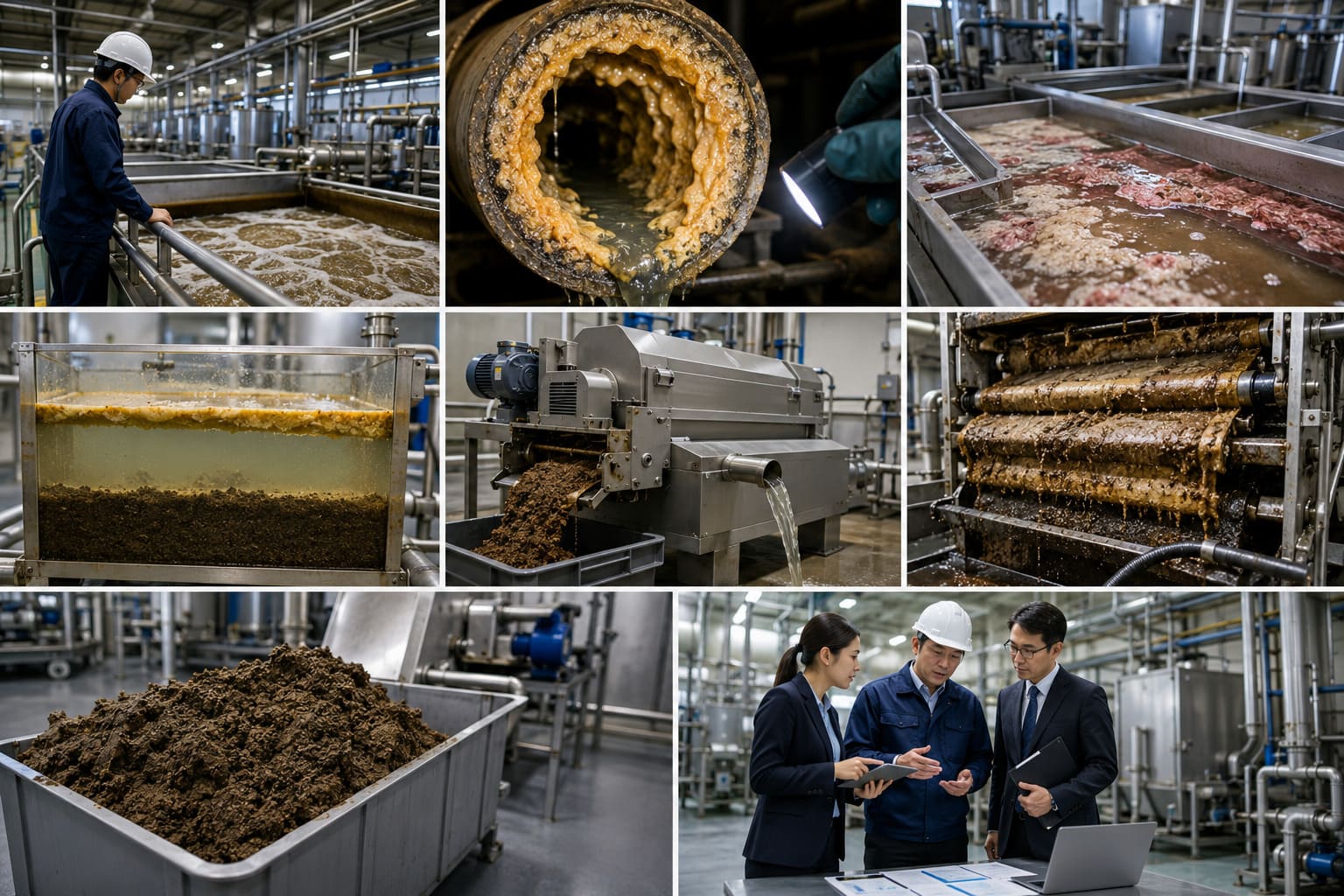
When warm wastewater carrying dissolved and emulsified fat cools as it moves through pipes and into treatment tanks, the fat solidifies and adheres to surfaces. Over time this builds into thick deposits that narrow pipe diameter, reduce flow, and eventually cause blockages. In treatment tanks, FOG forms floating mats that interfere with aeration and settling. This is not a maintenance failure — it is the predictable physical behaviour of fat in a cooling, moving system.
Why conventional screw presses fail with high-fat sludge
Screw press and belt press systems rely on physically squeezing liquid out of sludge through a fixed screen or filter belt. When the sludge is high in fat, that fat immediately blinds the screen openings — coating them with a film that water can no longer pass through. Throughput collapses, and operators are forced to stop the machine and manually scrub the screen. On a busy production line running two shifts, this can mean cleaning interventions several times per week, each one taking the equipment offline.
The hidden cost: sludge volume and disposal frequency
Food processing sludge that is poorly dewatered remains 90–95% water. Every cubic metre of water you fail to remove is water you pay to transport and dispose of. Disposal contractors charge by weight or volume, so wet sludge directly inflates your disposal bill — often the single largest recurring cost in a plant's wastewater operation.
Understanding Your Sludge: Fat, Fibre, and Solids
Before selecting equipment, it helps to understand the three components that define how food processing sludge behaves during separation.
- Fat and oil (FOG): The component that clogs conventional equipment. Emulsified fat is particularly difficult for screen-based systems because it spreads into a continuous film.
- Fibre and particulates: From vegetable matter, meat tissue, or packaging residue. Coarse fibre should be screened upstream; fine organic particulate is what the dewatering stage targets.
- Suspended and dissolved solids: The total solids concentration determines whether a given machine can process the sludge efficiently.
Ideal feed concentration: 2–7% and what that means in practice
The GreenCarry Wave Separator operates most efficiently when the incoming sludge is between 2% and 7% total solids. Most food processing sludge collected from dissolved air flotation (DAF) units or settling tanks falls naturally within or close to this range. Sludge thinner than 2% separates inefficiently; thicker than 7% reduces throughput. Knowing your feed concentration before selecting equipment is the single most important specification step — and the one most commonly skipped.
Why 'The Oilier, the Better' Is Actually True
This is the claim that sounds like marketing until you understand the mechanism behind it. The Wave Separator does not rely on a fixed screen that fat can blind. Instead, it uses a stack of slowly rotating wave-profile discs with precision slit gaps, combined with an internal blade agitation system that continuously moves between the disc faces.
The self-cleaning mechanism that grease cannot defeat
Because the blades are in constant cyclic motion, fat never gets the chance to form a stable film across the separation gaps. Any grease that begins to accumulate is immediately dislodged and carried forward with the solid fraction to the discharge outlet. The geometry simply never allows fat to compact against a static surface — which is precisely the failure mode that disables screw and belt presses.
In practice, this means a food plant that previously stopped its dewatering machine three or four times a week to scrape grease off a screen can run continuously, with maintenance reduced to a brief end-of-cycle rinse. The fattier the sludge, the more dramatic the contrast against conventional equipment — hence the phrase operators use: the oilier, the better.
Zero wash water operation: 90%+ water savings
Belt press systems consume continuous high-pressure wash water to keep filter belts clear of grease — water that itself becomes contaminated wastewater requiring treatment. The Wave Separator requires no wash water during operation. A short clean-water rinse at the end of each operating cycle is sufficient, cutting wash water consumption by more than 90% compared with belt press alternatives. For plants in water-stressed regions or facing water tariffs, this is a direct and measurable saving.
Low energy: 2 HP at full capacity
The Wave Separator runs at full processing capacity on a maximum of 2 HP (about 1.5 kW). A comparable screw press typically draws 3–5 kW and a centrifuge 15 kW or more. For a plant running its dewatering equipment 8 hours a day, the difference in electricity cost alone accumulates into thousands of dollars per year — quantified in the ROI section below.
ROI Breakdown: When Does the Investment Pay Back?
Most equipment discussions stop at purchase price. For a food processing plant, the more important question is how quickly better dewatering pays for itself through reduced disposal volume, lower energy use, and recovered operator time. The table below models a representative mid-sized food plant processing approximately 5,000 litres of sludge per day.
| Cost / Saving Factor | Conventional Setup (Belt Press) | Wave Separator | Annual Difference |
| Sludge cake moisture | 85–90% | 70–80% | Disposal volume cut 40–60% |
| Annual sludge disposal cost* | USD 24,000 | USD 10,000–14,000 | Save USD 10,000–14,000 |
| Energy cost (8 hr/day, 300 day) | ~USD 576 (4 kW) | ~USD 144 (1.5 kW) | Save ~USD 432 |
| Wash water + treatment | USD 600–900 | Near zero | Save USD 600–900 |
| Operator cleaning time | ~150 hrs/year | ~20 hrs/year | Recover ~130 hrs |
| Belt / screen replacement | USD 800–1,500/year | Bearings only: USD 150–300 | Save USD 650–1,200 |
* Disposal cost assumes USD 80–120 per wet tonne and illustrates the impact of moisture reduction on transported weight. Actual figures vary by region, contractor, and waste classification.
In this representative model, the combined annual savings from reduced disposal volume, lower energy and water use, and recovered labour typically fall in the range of USD 12,000–17,000. Against a single dewatering unit's capital cost, this points to a payback period that is frequently under two years — and in plants with high disposal tariffs, often well under one year. The largest lever by far is disposal volume reduction: removing more water from the sludge cake directly reduces the tonnage you pay to haul away.
Application Fit by Food Sector
Different food processing sectors generate sludge with different characteristics. The Wave Separator suits high-fat, high-organic streams particularly well.
| Sector | Sludge Characteristics | Wave Separator Fit | Notes |
| Meat & poultry processing | Very high fat, blood, tissue | Excellent | Classic 'oilier the better' case |
| Dairy | High fat, protein, lactose | Excellent | Watch CIP chemical pH for bearings |
| Edible oil / frying lines | Extremely high FOG | Excellent | Screen coarse debris upstream |
| Fruit & vegetable | High fibre, moderate fat | Good | Pre-screen large fibrous matter |
| Beverage / brewing | Organic, lower fat | Good | Confirm feed at 2–7% solids |
| Seafood processing | High fat, salt, protein | Excellent | Salt content does not impair separation |
Important note: the Wave Separator is designed for organic sludge. It is not suited for streams containing significant sand, grit, or metal particles. Where these are present (for example, root-vegetable washing with heavy soil load), a grit removal or settling step upstream is essential.
Meeting Discharge Regulations for Food Plants
Food processing plants discharging to municipal sewers or surface water face limits on FOG, COD, BOD, and suspended solids. Many municipalities impose surcharges when effluent exceeds defined thresholds, making effective pre-treatment both a compliance and a cost issue.
- FOG limits: Many sewer authorities cap FOG discharge (commonly in the range of 100–150 mg/L); exceeding this triggers surcharges or enforcement.
- COD / BOD: High organic load attracts volumetric surcharges from treatment authorities; reducing solids load lowers these charges.
- Suspended solids: Effective dewatering sharply reduces SS in the discharged liquid fraction.
- Equipment compliance: The Wave Separator holds CE certification, supporting compliance documentation for EU and CE-referencing export markets.
- Records: Maintain operating logs, throughput data, and maintenance records for inspection readiness.
Before and After: Typical Performance Indicators
| Parameter | Before (Raw Food Sludge) | After Wave Separator | Improvement |
| FOG concentration | High / variable | Sharply reduced in liquid fraction | Lower sewer surcharge risk |
| Suspended Solids | 10,000–30,000 mg/L | < 800 mg/L (liquid) | > 95% reduction |
| COD | 10,000–35,000 mg/L | < 2,000 mg/L | ~90% reduction |
| Cake moisture | 85–95% | 70–80% | Volume cut 40–60% |
| Equipment downtime for cleaning | Several stops/week | End-of-cycle rinse only | Near-continuous operation |
Performance figures represent typical ranges from food and beverage installations. Actual results depend on sludge composition, upstream treatment, and operating schedule.
Frequently Asked Questions
Q1: Our wastewater has extremely high grease content. Will the equipment clog like our current press?
No — and this is the core advantage. The Wave Separator's continuous blade agitation prevents grease from forming a stable film across the separation gaps. Unlike screen-based presses, there is no fixed surface for fat to blind. In high-FOG food processing applications, this is precisely where the technology outperforms conventional equipment most dramatically.
Q2: How much can we realistically expect to save on sludge disposal?
The primary saving comes from removing more water from the sludge cake, which reduces the weight and volume you pay to dispose of. Moving from 85–90% moisture to 70–80% typically cuts disposal volume by 40–60%. For a plant spending USD 24,000 a year on disposal, that can translate to USD 10,000–14,000 in annual savings — usually the single largest line item in the ROI.
Q3: Can it handle the chemical residues from our CIP (clean-in-place) cycles?
CIP chemicals are typically caustic or acidic cleaning agents. The Wave Separator's components tolerate a range of pH conditions, but strongly acidic environments accelerate bearing wear. If your sludge carries significant CIP chemical residue, discuss the operating pH with the engineering team so the bearing maintenance interval can be specified correctly. The bearings are the only consumable, and they are inexpensive to replace.
Q4: Does it work for a plant running two or three shifts continuously?
Yes. The Wave Separator is designed for continuous operation, which is one of its main advantages over screen-based presses that require frequent cleaning stops. For multi-shift plants, sizing should match peak daily sludge volume — the engineering team can recommend the right configuration based on your throughput.
Q5: We already have a DAF unit. Does this replace it or work alongside it?
It works alongside it. A DAF (dissolved air flotation) unit separates and concentrates FOG and solids into a float sludge, typically at 2–5% solids — which is within the Wave Separator's ideal feed range. Installing a Wave Separator on the DAF float outlet dewaters that sludge efficiently, reducing the volume sent to disposal. This is one of the most common and effective configurations in food processing.
Q6: What is the footprint? Our plant is tight on floor space.
The Wave Separator has a notably compact footprint compared with belt presses or centrifuges of equivalent capacity, which is a frequent reason food plants choose it during retrofits. It can usually be accommodated within existing treatment areas without major civil works. Share your available space and sludge volume with the team for a fit assessment.
Turn Your Grease Problem into a Predictable Process
Grease does not have to mean weekly equipment failures and rising disposal invoices. With the right separation technology, the high-fat sludge that defeats conventional presses becomes a clean, continuous, low-maintenance process — and the savings on disposal alone often justify the investment within months.
Talk to GreenCarry's engineering team about your plant. Share your sludge volume, feed concentration, and current disposal cost — we will provide a model recommendation, a tailored ROI estimate, and a compliance assessment for your discharge requirements.
- Wave Separator product page: greencarrytech.com/en/p101-wave-separator
- Food & beverage solution overview: greencarrytech.com/en/applicationc2-food-and-beverage-processing
- Send an enquiry: info@greencarrytech.com