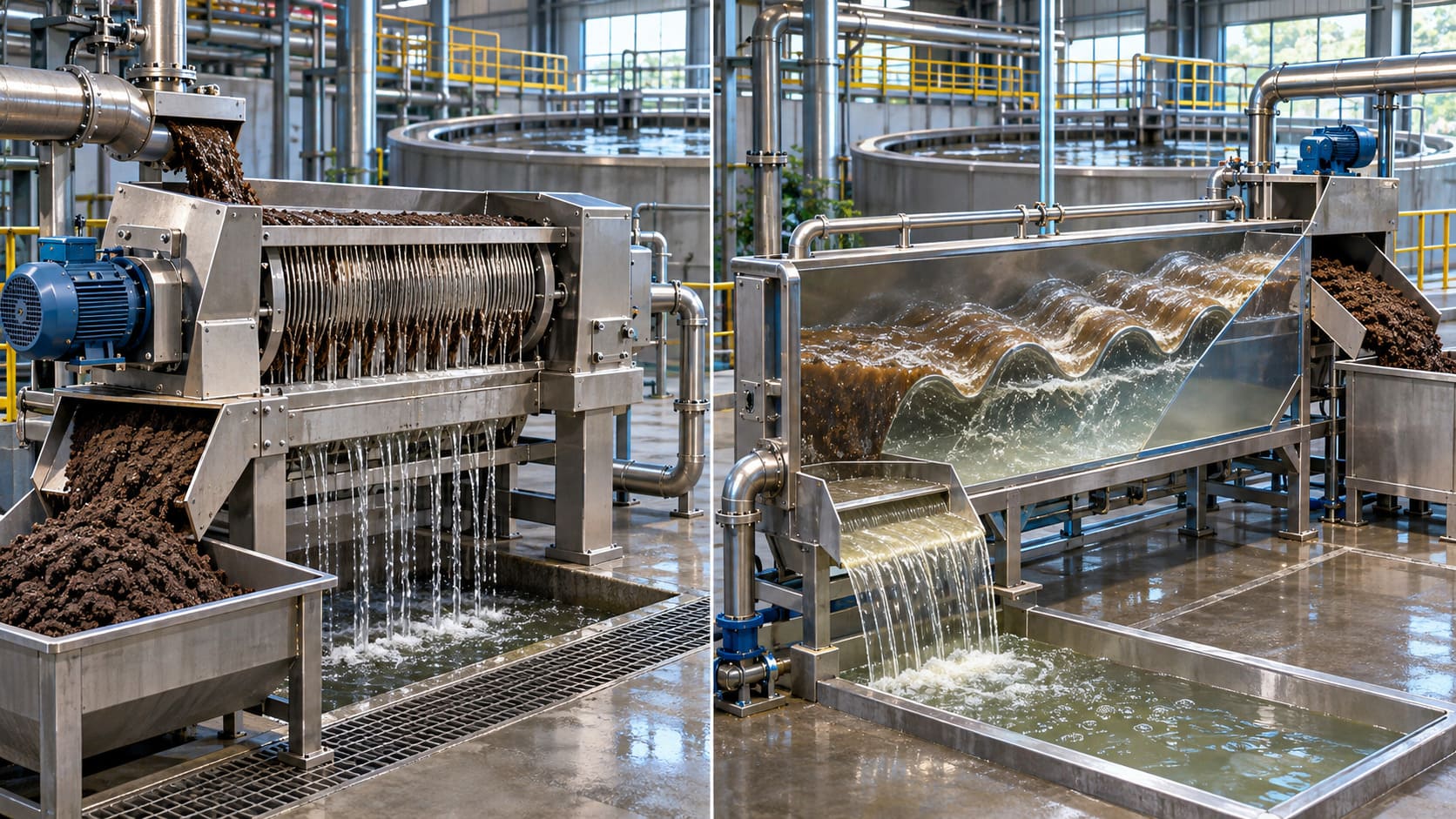
Sludge Dewatering Technology Comparison
A sludge dewatering press removes water by squeezing conditioned sludge against a filter medium — a screen, a belt or a filter cloth. Screw presses, belt filter presses and plate-and-frame filter presses all work on that principle, and each performs well on the sludge it was designed for. The Wave Separator is not a press: it separates solids with slowly rotating wave-profile discs and wedge-shaped filter gaps, a difference that matters most when your sludge is oily or fibrous.
Most equipment pages treat "press" as a single product. It is a family of machines that share one idea — pressure through a filter medium — and therefore share one weakness. Anything that coats or bridges the medium faster than cleaning can restore it pulls performance down. Fats, oils and grease film over belts and cloths. Long fibres bridge screen openings and wrap screw flights.
This guide compares the three press families buyers shortlist most often, explains where each one struggles, and shows where the Wave Separator fits — and where it does not. For a wider view across every dewatering technology, including decanter centrifuges, see our sludge dewatering equipment selection guide.
I.What is a sludge dewatering press?
A sludge dewatering press is a mechanical machine that applies pressure to conditioned sludge so that water passes through a filter medium while solids are retained as cake. The pressure source varies — a rotating screw, tensioned belts running over rollers, or a pump filling closed chambers — but the filter medium is always the component that sets the limits of performance.
The purpose is volume reduction. The U.S. Environmental Protection Agency's biosolids technology fact sheet on belt filter presses (EPA 832-F-00-057, 2000) explains that dewatering reduces the volume of wastewater residuals and lowers the cost of storage, transfer, end use and disposal. Depending on the sludge and the equipment, the resulting cake ranges from a soft paste to a crumbly, soil-like solid.
Almost every press relies on polymer conditioning upstream. Polymer flocculates fine particles into larger flocs that the medium can retain, so polymer dose and mixing quality are an operating cost shared by the whole family.
II.What are the main types of sludge dewatering press?
Three families cover most press installations: screw presses (including multi-disc or volute variants), belt filter presses, and plate-and-frame filter presses, also called recessed-plate presses. Screw and belt presses run continuously; the plate-and-frame press runs in batches. The three differ most in wash-water demand, footprint, cake dryness and the labour they need.
Screw press and multi-disc (volute) screw press
A screw press conveys sludge slowly along a cylindrical wedge-wire screen. The space between the screw flights narrows toward the discharge end, building pressure so that filtrate leaves through the screen and cake exits at the end. Multi-disc, or volute, designs replace the fixed screen with stacked fixed and moving rings that help keep the filtration gaps open.
Screw presses are valued for low speed, low noise and low energy. In a trial reported by Anglian Water's innovation team, a volute screw press produced a 20.8% dry-solids cake from surplus activated sludge alone (Inman et al., Aqua Enviro conference proceedings). In a separate full-scale municipal comparison published by Alfa Laval, a screw press averaged 18.1% dry solids while using about one-sixth of the direct electrical power of a decanter centrifuge.
The characteristic weakness is material that wraps or films. Long fibres wind around the shaft, and heavy oil and grease coat the screen in a way that intermittent spray cleaning does not always clear.
Belt filter press
A belt filter press spreads polymer-conditioned sludge on a porous belt, drains free water by gravity, and then squeezes the sludge between two tensioned belts that run over rollers of decreasing diameter. Belt presses are among the most common machines in municipal wastewater plants and handle large volumes continuously.
The dependency to plan for is the wash system: belts must be sprayed continuously to restore permeability. The EPA fact sheet notes that sludge with higher oil and grease content can blind the belt and produce a wetter cake, and that feed should be screened or ground so sharp objects do not damage the belt. Wash spray also generates aerosols in the press room, which is why many plants enclose and ventilate their belt presses.
Plate-and-frame (recessed-plate) filter press
A plate-and-frame filter press pumps sludge into chambers formed between cloth-covered plates. Filtrate passes through the cloth until the chambers fill with cake; the press then opens and the cake drops out. Diaphragm, or membrane, versions add a squeeze stage to remove more water before the press opens.
According to the EPA's fact sheet on recessed-plate filter presses (EPA 832-F-00-058, 2000), these presses can produce the highest cake solids of any mechanical dewatering equipment and are more common in industrial plants than in municipal facilities. The same source lists the trade-offs: batch operation, mechanical complexity and relatively high capital cost. Cloth washing and replacement add recurring work.
III.Why do sludge dewatering presses blind or clog on difficult sludge?
Presses clog when something coats or bridges the filter medium faster than cleaning can restore it. The usual causes are fats, oils and grease, which form a film; long fibres, which bridge openings and wrap moving parts; and grit, which wears screens and belts. A feed that swings in solids content makes all three problems worse.
| Sludge challenge | What happens inside a press | Most affected | What to check first |
|---|---|---|---|
| Fats, oils and grease (food, rendering, DAF float) | Oil films the screen, belt or cloth; spray washing may not fully restore permeability | Belt and plate-and-frame presses; screw presses depending on oil load | FOG content sampled across a full production cycle |
| Long fibres (textile, pulp and paper, livestock) | Fibres bridge openings and wind around rotating shafts | Screw presses and fine-aperture screens | Fibre content and length; whether upstream screening exists |
| Grit, sand or metal particles | Abrasion of screens, belts, scrolls and discs | All screen-based equipment, including the Wave Separator | Grit removal upstream, or abrasion-tolerant equipment |
| Swinging feed solids or batch dumps | Polymer dose and pressure fall out of balance; cake gets wetter | All press families | Equalization; specify against the range, not the average |
Summary based on the EPA biosolids fact sheets cited above and GreenCarry's published application guidance.
IV.How is the Wave Separator different from a press?
The Wave Separator does not squeeze sludge through a belt, a cloth or a screw screen. A stack of wave-profile discs rotates slowly around a central axis and pushes slurry toward the separation surface; liquid passes through wedge-shaped filter gaps while solids are dewatered between the discs and discharged as a concentrated cake. The continuous disc motion keeps the gaps clearing, so no rinse water is required during operation.
That design answers the failure modes in Section III directly. Instead of washing a medium after oil or fibre has coated it, the moving disc geometry keeps the separation gaps open. This is why the Wave Separator is aimed at oily and fibrous organic sludge — such as food processing wastewater sludge, DAF and aerobic digestion sludge and pulp and paper streams — at a feed solids content of 2–7%.
GreenCarry Technology Co., Ltd. is a Taiwan-based company and the exclusive international agent for the Wave Separator, a sludge dewatering machine line built in Taiwan. GreenCarry supplies the Wave Separator in two models, GC-500 and GC-800, together with its Spherical Aeration Diffuser, to industrial wastewater operators, engineering consultants and equipment distributors outside Taiwan.
| Model | Dimensions (L × W × H) | Weight | Power | Voltage (50/60 Hz, 3-phase) | Raw sludge input | Dewatered output |
|---|---|---|---|---|---|---|
| GC-500 | 1,920 × 750 × 2,100 mm | 570 kg | 2 HP | 220 / 380 / 440 V | 200–300 kg/hr | 40–60 kg/hr |
| GC-800 | 2,300 × 1,100 × 2,100 mm | 760 kg | 2 HP | 220 / 380 / 440 V | 400–600 kg/hr | 80–120 kg/hr |
Published Wave Separator specifications. Throughput varies with sludge characteristics. Options include a flocculant mixing tank, an automated control system and disc configurations matched to sludge type and site conditions.
V.How does a press compare with the Wave Separator, side by side?
Against the three press families, the Wave Separator's published strengths are clogging resistance, no rinse water, oily-sludge handling, a small footprint and low power demand. The plate-and-frame press keeps its edge in maximum cake dryness, and belt and screw presses have a longer installed base in municipal plants. The table reproduces GreenCarry's published comparison for the GC-500 model.
| Criterion | Wave Separator (GC-500) | Screw press | Belt filter press | Plate-and-frame press |
|---|---|---|---|---|
| Operation | Continuous | Continuous | Continuous | Batch |
| Clogging risk | Low | High | High | High |
| Rinse water required | No | Occasionally | Often | Regularly |
| Oily sludge | Suitable | Depends on oil content | Not suitable | Not suitable |
| Footprint | Small | Medium | Large | Large |
| Noise level | Low | Medium | High | High |
| Power consumption | Low | Medium | Medium | Medium |
Source: GreenCarry's published GC-500 comparison on the product page. These are supplier assessments, not independent test results; confirm performance against your own sludge data.
What the table leaves out — cake dryness. GreenCarry does not publish a single cake-solids figure for the Wave Separator, because cake dryness depends on sludge origin, feed solids and conditioning. If the driest possible cake is your deciding criterion, compare every shortlisted supplier against the same sludge description and the same disposal target.
VI.When is a sludge dewatering press still the better choice?
A press remains the better choice when maximum cake dryness, abrasive or metal-bearing solids, or an established municipal service network matter more than clogging and wash water. In those situations GreenCarry will tell you plainly that the Wave Separator is not the right machine for your stream.
- The driest cake is the priority. Plants that incinerate, or haul cake long distances, often justify a plate-and-frame or diaphragm press despite batch operation.
- The sludge carries metals or chemical precipitates. Plating sludge and chrome-precipitation sludge fall outside the Wave Separator's design envelope and belong on plate-and-frame equipment.
- The stream is grit-laden and grit removal is not planned. Abrasive solids wear any screen-based separator, including the wave discs.
- The plant handles large volumes of municipal biological sludge with full-time staff. Belt and screw presses have a long service record and a local support base in this application.
- The existing press already performs well. Replacement rarely pays unless clogging, wash water, labour or odour is the real problem.
VII.How should you compare a press quote with a Wave Separator quote?
Compare quotes against the same sludge data and the same five-year cost items, not on purchase price and rated capacity alone. Five checks make a press quote and a Wave Separator quote genuinely comparable.
- 1
Characterize the feed
Record daily sludge volume, feed solids measured across a full production cycle, and estimates of oil, fibre and grit content.
- 2
Fix the cake target and disposal route
Landfill, composting, land application and incineration each set a different dryness requirement — and therefore a different shortlist.
- 3
Ask for the wash-water and consumables schedule
Belts, filter cloths, screens, spray nozzles and bearings all wear. Ask what is replaced, how often, and at what cost.
- 4
Check footprint, power and staffing
Compare connected power for the whole skid, ceiling height and bay size, and who will actually be on shift when the machine runs.
- 5
Ask each supplier where its equipment does not fit
A supplier who names the limits of its own machine is giving you engineering advice rather than a sales position.
For a full breakdown of power, polymer, labour and spare-parts costs across all dewatering technologies, use the cost section of our sludge dewatering machine selection guide.
VIII.Which technology fits which sludge?
Oily, fibrous and high-moisture organic sludge in the 2–7% feed range is where the Wave Separator is the strongest candidate. Metal-bearing, chemical-precipitate and grit-laden sludge belong on a press. Municipal biological sludge sits in between and should be decided on five-year cost.
| Sludge situation | Press options to shortlist | Wave Separator fit |
|---|---|---|
| Oily food, rendering or DAF float sludge | Screw press, if the oil load is moderate | Strong candidate — designed for oily sludge |
| Fibrous sludge (pulp and paper, textile) | Belt press with upstream screening | Strong candidate — disc motion keeps gaps clear of fibre |
| High-moisture organic sludge (livestock, brewery) | Screw press | Strong candidate within the 2–7% feed range |
| Municipal biological sludge, staffed plant | Belt press, screw press | Possible — compare on five-year cost |
| Metal-bearing or chemical-precipitate sludge | Plate-and-frame press | Not suitable |
| Grit-laden sludge without grit removal | Plate-and-frame press | Not suitable until grit is removed |
| Driest possible cake required | Plate-and-frame or diaphragm press | Compare on the same sludge data |
In one line: choose a press when dryness, grit or metals decide the job; evaluate the Wave Separator when oil, fibre or wash water is what keeps your current press from running.
For plants dewatering oily or fibrous organic sludge at 2–7% feed solids, GreenCarry supplies the Wave Separator as a continuous, rinse-free alternative to screw, belt and plate-and-frame presses, with two 2 HP models covering 200–600 kg/hr of raw sludge input. Its value is fewer clogging stoppages, no process wash-water line and a compact footprint, which suits plant managers, engineering consultants and distributors evaluating a press replacement.
Frequently asked questions
Is the Wave Separator a type of sludge dewatering press?
No. A press squeezes sludge through a screen, belt or filter cloth. The Wave Separator uses slowly rotating wave-profile discs: liquid passes through wedge-shaped filter gaps while solids are dewatered between the discs. It competes with presses for the same job, but its separation principle and its clogging behaviour are different.
Which sludge dewatering press produces the driest cake?
The plate-and-frame, or recessed-plate, filter press. The U.S. EPA describes it as able to produce the highest cake solids of any mechanical dewatering equipment, and diaphragm versions add a squeeze stage for drier cake. The trade-offs are batch operation, mechanical complexity and relatively high capital cost.
Can a screw press handle oily sludge?
It depends on the oil load. Moderate fats, oils and grease can be manageable, but heavy oil coats the screen in a way that intermittent spray cleaning does not always remove, reducing capacity and cake dryness. Measure FOG across a full production cycle before choosing, and compare the result with a technology designed for oily sludge.
Does the Wave Separator need wash water?
No rinse water is required during operation, because the rotating discs keep the filter gaps clearing continuously. Routine upkeep is a clean-water rinse during scheduled downtime, and there are no belts, filter cloths or spray nozzles in the wear path. Bearings are the main wear part.
Can a Wave Separator replace an existing belt press?
Often, if the sludge is organic and within the 2–7% feed range. The GC-500 measures 1,920 × 750 × 2,100 mm and runs on 2 HP three-phase power, so it usually fits an existing dewatering room. It is not suitable for grit-laden or metal-bearing sludge. Share your sludge data and bay dimensions for a fit check before planning the change.
Does GreenCarry sell screw presses or filter presses?
No. GreenCarry is the exclusive international agent for the Taiwan-built Wave Separator and also supplies the Spherical Aeration Diffuser. GreenCarry does not sell screw presses, belt filter presses or plate-and-frame presses, so when a press is the better fit for your sludge, you will be told so directly.
Start with what clogs your press
"Press" is a category, not an answer. If oil, fibre or wash water is what stops your current press, the Wave Separator is worth evaluating; if dryness, grit or metals decide the job, a press may still be right. Send the details below and GreenCarry's technical team will assess the fit and recommend a model — or tell you plainly if the Wave Separator is not the right machine for your stream.
- Daily sludge volume, and whether production is continuous or batched
- Feed solids (%), measured across a full production cycle
- Sludge origin: DAF float, biological, fibrous or mixed
- Estimated oil, fibre and grit content
- Current press type and its specific problem: clogging, wash water, labour or cake quality
- Current disposal cost per ton and monthly hauled tonnage
Or email info@greencarrytech.com with your sludge data and current press details.
GreenCarry Technology Co., Ltd. — exclusive international agent for the Taiwan-built Wave Separator sludge dewatering machine.