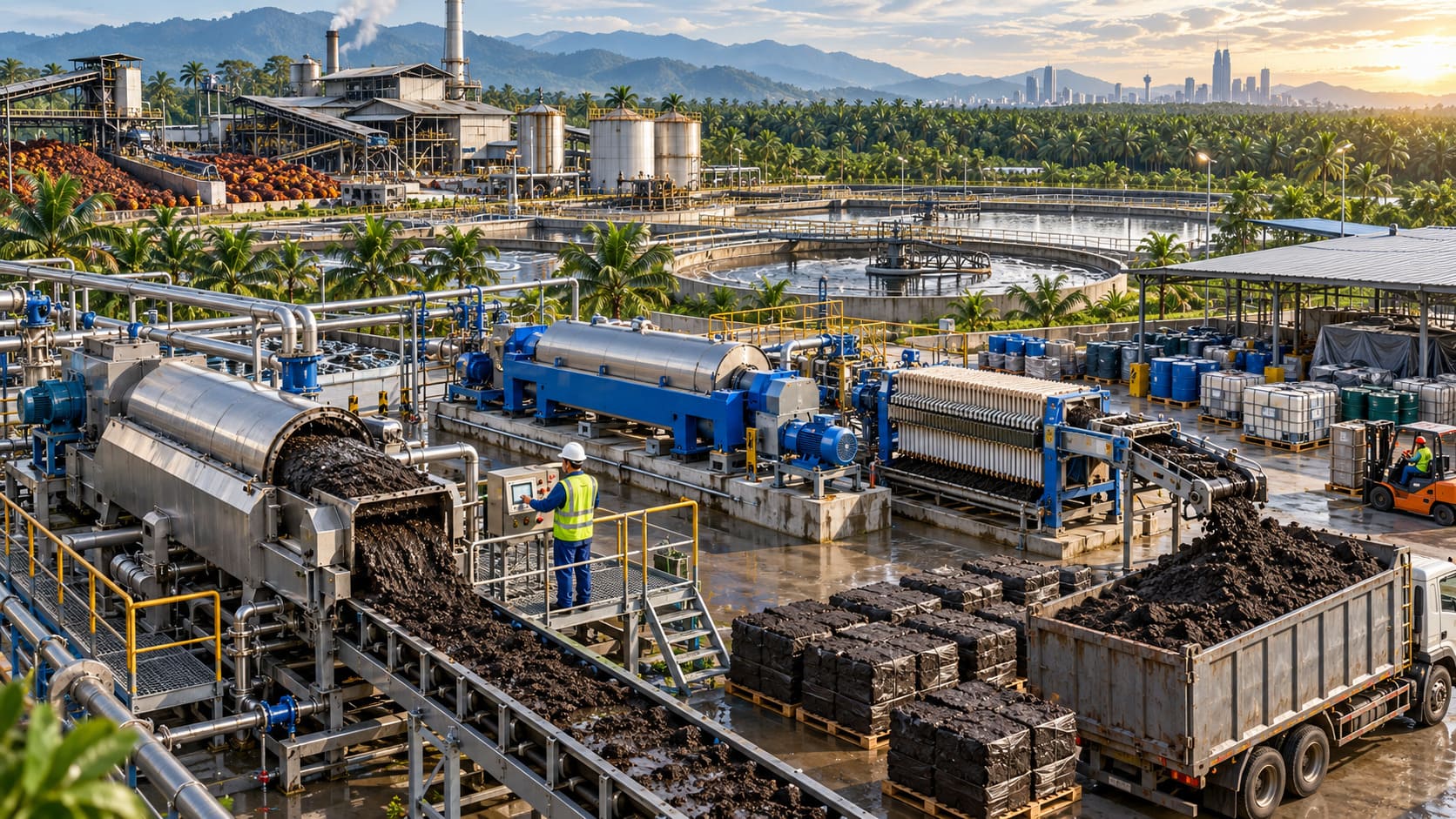
There is a specific number in Malaysian environmental law that sells dewatering equipment better than any brochure.
Under the Environmental Quality (Scheduled Wastes) Regulations 2005, a waste generator may store scheduled waste on site for 180 days or less, provided the quantity does not exceed 20 metric tonnes. Beyond that, written approval from the Director General of Environment is required (Azmi & Associates).
Scheduled waste is measured by weight. Wastewater treatment sludge is mostly water. A factory that dewaters its sludge does not merely reduce its disposal invoice — it changes whether it crosses a regulatory threshold at all.
That is the opening line of a Malaysian sales conversation, and it is why GreenCarry Technology is appointing distributors across Peninsular and East Malaysia.
Why Malaysia is a strong market for this product
The regulatory framework has teeth
Malaysia's environmental regime rests on the Environmental Quality Act 1974, with Section 34B governing scheduled waste control, alongside provisions on air, soil and water pollution. The 1996 amendment set penalties of up to RM500,000 or five years' imprisonment for illegal trafficking of scheduled wastes.
The Environmental Quality (Scheduled Wastes) Regulations 2005 operationalise this, classifying 77 waste types across five groups (SW 1 through SW 5). Generators are responsible for ensuring scheduled waste is properly stored, treated on site, recovered, or delivered to prescribed premises for treatment or disposal. Containers must be labelled with the generation date, generator name, address and contact number.
For a factory manager, the practical consequences are a storage clock, a weight threshold, a licensed disposal contractor invoiced by the tonne, and personal exposure if any of it goes wrong.
Dewatering addresses three of those four at once.
The industrial base generates enormous sludge volumes
Malaysia's export manufacturing economy is unusually sludge-intensive:
Palm oil — Malaysia's largest agro-industrial sector. Palm oil mill effluent is among the highest-strength industrial wastewaters in the world, treated through ponding and increasingly through engineered systems, all of which produce large volumes of sludge. Mills are typically located away from urban infrastructure, which makes on-site volume reduction more valuable than in a city-adjacent plant.
Rubber processing — a second major agro-industrial stream with high organic load and established effluent discharge requirements.
Food and beverage processing — a dense base of mid-sized producers, including a large halal manufacturing sector, all running DAF pretreatment. See food and beverage processing applications.
Electronics and semiconductor — concentrated in Penang, Kulim and the Klang Valley, generating chemical and metal-bearing sludges under tight discharge control. See electronics industry applications.
Metal finishing and electroplating — supplier base to the electronics and automotive sectors, producing hydroxide sludges that fall squarely into scheduled waste categories. See metal processing wastewater treatment.
Livestock and agriculture — poultry and swine operations with nutrient-rich waste streams. See livestock industry applications and algae harvesting and agricultural wastewater.
Textile and dyeing — an established sector with colour and chemical load under Standard A and Standard B discharge limits. See textile and tannery dyeing plant applications.
Discharge standards keep the treatment plants running
Malaysia's industrial effluent regime operates on a two-tier structure — Standard A for discharge upstream of a water supply intake, Standard B for everywhere else — with Standard A materially tighter. Palm oil mill effluent is governed by its own set of limits under the crude palm oil regulations.
The relevance to a dewatering distributor is indirect but important: discharge standards are what force factories to operate DAF and biological treatment in the first place, and those processes are what generate the sludge. Every tightening of an effluent limit, and every enforcement action, expands the installed base of treatment plants producing sludge that someone has to handle.
A distributor selling dewatering equipment in Malaysia is therefore selling downstream of the compliance driver, not into it. The factory has already spent the money on the treatment plant. What it has now is a by-product it did not budget for, accumulating in a storage area with a clock on it.
The buyer profile fits the product exactly
This is the part that matters most commercially, and it is where Malaysia differs from Europe or North America.
The typical Malaysian buyer for this product is a small-to-mid-sized factory that has a DAF or biological treatment plant, a growing sludge problem, a licensed disposal contractor charging by the tonne, and no realistic prospect of approving a decanter centrifuge.
Centrifuges are specified into Malaysian projects, but at a capital level and a maintenance burden that excludes most of the SME manufacturing base. Filter presses are common but labour-intensive, batch-operated, and vulnerable to blinding on oily and chemically conditioned sludges.
What has been missing in this segment is a continuous mechanical dewatering unit at a capital level a factory owner can approve directly, with a maintenance profile a general maintenance team can handle without a specialist contractor.
That is the gap this product line occupies.
What you would be selling
GreenCarry Technology Co., Ltd. is the exclusive international agent for a Taiwan-built sludge dewatering equipment line. The core product is the Wave Separator, a continuous mechanical solid-liquid separator.
The working principle is a stack of slowly rotating wave-profile discs on a central axis. The discs push slurry toward the separation surface; liquid passes out through wedge-shaped filter gaps while solids are progressively compressed and conveyed forward as cake. The moving disc surfaces clear the filter gaps during operation — the design response to the blinding that oily and chemically conditioned solids cause on fixed-media equipment such as filter presses.
| GC-500 | GC-800 | |
| Feed rate | 200–300 kg/hr | 400–600 kg/hr |
| Cake output | 40–60 kg/hr | 80–120 kg/hr |
| Suitable feed solids | 2–7% | 2–7% |
| Motor | 2 HP | 2 HP |
| Power supply | 220 / 380 / 440 V, 3-phase, 50/60 Hz | 220 / 380 / 440 V, 3-phase, 50/60 Hz |
| Footprint | 1,920 × 750 × 2,100 mm | 2,300 × 1,100 × 2,100 mm |
| Dry weight | 570 kg | 760 kg |
Full specifications are on the Wave Separator sludge dewatering machine product page.
Why Taiwan-built equipment sells well in Malaysia
Malaysian industrial buyers have a well-developed sense of where equipment sits on the price-quality curve, and they buy accordingly.
Taiwanese industrial equipment occupies a recognised position in this market: engineered and built to a standard above the lowest-cost regional alternatives, at a capital level well below European and Japanese equivalents. For a factory owner weighing a purchase against a monthly disposal invoice, that position is frequently the one that closes.
Three further arguments carry weight locally:
Power draw. A 2 HP motor against Malaysian industrial tariffs is a small, predictable operating cost — and a strong contrast with centrifuge connected loads.
Maintenance without specialists. Low rotational speed means no high-speed bearing programme, no balancing, no scroll wear cycle. For a mill in Sabah or Sarawak, or an estate-adjacent processing plant, the ability to maintain equipment without flying in a specialist is worth more than a marginal performance difference.
Continuous operation. Unlike a batch filter press, the unit runs continuously alongside a DAF that skims continuously — removing the labour cycle that makes presses unpopular with plant managers running lean shifts.
Parallel scaling. Larger duties are met by adding units rather than specifying a single large frame. A mill can start with one machine and expand, and can take one unit offline for service without stopping sludge handling.
Being clear about the limits
The equipment suits feed in the 2–7% solids range, chemically conditioned with established floc structure. It is not the right answer for grit-laden streams with abrasive coarse sand not removed upstream, for unconditioned sludge with no floc structure, or for free-oil-dominant streams better handled by skimming or oil recovery upstream.
In palm oil applications in particular, the upstream configuration matters and should be assessed case by case rather than assumed. A distributor who assesses honestly builds a reference list; one who does not builds a service problem in a location that is expensive to reach.
The distributor economics
Four revenue streams:
Equipment margin on unit sales into the industrial base.
Multi-unit and expansion sales. Capacity scales by adding units, so a proven single installation is a live opportunity for more — and Malaysian industrial groups frequently operate multiple plants under common ownership. One satisfied mill inside a plantation group is an introduction to the rest of the group.
Installation, commissioning and polymer programme. Dewatering performance depends on conditioning chemistry. The distributor who owns the polymer supply owns recurring revenue and the technical relationship that protects the account from displacement.
Service and spares across the installed base — with a meaningful advantage for distributors who can service East Malaysia, where support coverage is thin and buyers pay for reliability of response.
The structural advantage here is entry ticket size in an SME-dominated market. A single GC-500 is a purchase a factory owner or plant manager can often approve directly. In a market where capital approval chains are short and decisions are made by owners rather than committees, that shortens the sales cycle dramatically compared with large dewatering programmes.
Building the payback argument
Based on the equipment's published input and output ratings, the mass of material leaving site falls by roughly 75–80%, with separated filtrate returned to the front of the treatment process.
Run that against three of the customer's own numbers:
- The disposal contractor's rate per tonne — the direct saving, and the easiest to evidence
- Transport frequency — fewer collections, which matters disproportionately for remote mills
- The 20-tonne / 180-day storage threshold — whether reduced tonnage keeps the site under the limit that would otherwise require Director General approval
The third argument is the one competitors do not make, and it is the one that moves a compliance-conscious factory manager from interest to purchase order. Distributors should be able to discuss it accurately.
What GreenCarry provides to distributors
- Technical training on operation, sizing, polymer conditioning and troubleshooting
- Application engineering support on live opportunities — send sludge data and receive unit count, footprint, power requirement and lead time
- After-sales support and spare parts supply
- Marketing and technical materials in English
- Territory arrangements discussed case by case, based on coverage capability and market plan
Details are on the global partnership opportunities page.
Malaysia's proximity to Taiwan is a practical advantage on both lead time and the cost of technical support visits, relative to European or American territories.
Who this partnership suits
A good fit:
- Water and wastewater treatment equipment suppliers with an existing Malaysian industrial account base
- Environmental consultancies and licensed contractors working with scheduled waste generators
- Engineering and contracting firms building effluent treatment plants for industrial clients
- Companies with servicing capability in East Malaysia, where coverage is thinnest
- Suppliers already serving the palm oil, rubber, food processing or electronics sectors
Not a fit:
- Trading companies without technical capability — this product requires application engineering at quotation and support after commissioning
- Distributors expecting a drop-ship relationship with no local service capability
- Partners unwilling to develop polymer conditioning expertise, where most field performance problems originate
How a first sale typically develops
For distributors building a plan, the Malaysian sales motion for this product tends to follow a recognisable pattern.
It starts with an existing account — a factory the distributor already supplies with treatment chemicals, equipment or service. The distributor asks two questions: what does the disposal contractor charge per tonne, and how much sludge leaves the site each month. Both numbers are usually available immediately, because the factory is already paying them.
From there, the sludge is characterised: solids percentage, whether the stream is chemically conditioned, and what the upstream process looks like. That data goes to GreenCarry for sizing, and comes back as a unit count, footprint, power requirement and lead time.
The proposal is then built on the customer's own arithmetic — tonnage reduction against their contractor's rate, plus collection frequency, plus the storage threshold position. Because a single unit is typically within a plant manager's or owner's approval authority, the decision does not usually escalate to a lengthy capital process.
The first installation then does the selling. In Malaysia's industrial networks — particularly within plantation groups and industrial estates — a working reference installation that a prospective buyer can visit is worth more than any quantity of literature.
How to start a conversation
We will want to understand:
- Your current customer base and the sectors you already serve
- The territory you can realistically service — Peninsular, East Malaysia, or both
- Your technical and after-sales capability
- Whether you have live opportunities that could become a first reference installation
We will provide specifications, sizing support, commercial terms and lead times.
Frequently asked questions
Is GreenCarry the manufacturer? No. GreenCarry Technology Co., Ltd. is the exclusive international agent for a Taiwan-built sludge dewatering equipment line. Domestic Taiwan sales are handled separately by the manufacturing partner.
How does dewatering relate to Malaysia's scheduled waste rules? Scheduled waste storage limits and disposal charges are based on weight. Reducing the water content of sludge reduces the tonnage that has to be stored, notified and disposed of. Under the Environmental Quality (Scheduled Wastes) Regulations 2005, on-site storage is permitted for 180 days or less where the quantity does not exceed 20 metric tonnes; beyond that, written approval from the Director General is required. Generators should confirm the classification and obligations applying to their specific waste stream.
Is the equipment suitable for palm oil mill sludge? It is designed for sludge in the 2–7% solids range with established floc structure, which covers many but not all mill configurations. The upstream treatment arrangement determines suitability, so each site should be assessed rather than assumed. Send us the sludge data and we will tell you honestly whether it fits.
What is the electrical supply requirement? 220 / 380 / 440 V, three-phase, 50/60 Hz, with a 2 HP motor on both models — compatible with standard Malaysian industrial supply.
What size factories does this suit? Small-to-mid-sized industrial generators producing sludge in the range a GC-500 or GC-800 handles, or multiples of those units. This is deliberately the segment that cannot justify a decanter centrifuge.
How does it compare with a filter press? It runs continuously rather than in batches, which removes the labour cycle of press operation, and the self-cleaning wedge-gap geometry is designed to resist the blinding that oily and chemically conditioned sludges cause on fixed media. A press will typically produce a drier cake. The trade-off is labour and continuity against cake dryness.
Do distributors get exclusive territory? Territory arrangements are discussed case by case based on coverage capability and market plan.
Discuss a Malaysian distributorship
If you sell into industrial wastewater accounts in Malaysia and your customers are paying by the tonne to dispose of sludge that is mostly water, there is a straightforward argument to make and a product positioned to make it.
Tell us your territory, your customer base and your service capability, and we will come back with equipment details, commercial terms and support on any live opportunities you are already working.
Apply to become a GreenCarry partner · Contact us directly · info@greencarrytech.com
Related reading: Becoming a sludge dewatering equipment distributor in North America · Distributing sludge dewatering equipment in Europe under the new Urban Wastewater Treatment Directive · Becoming an Australian distributor: EESS, waste levies and the responsible supplier role · Wave Separator sludge dewatering machine