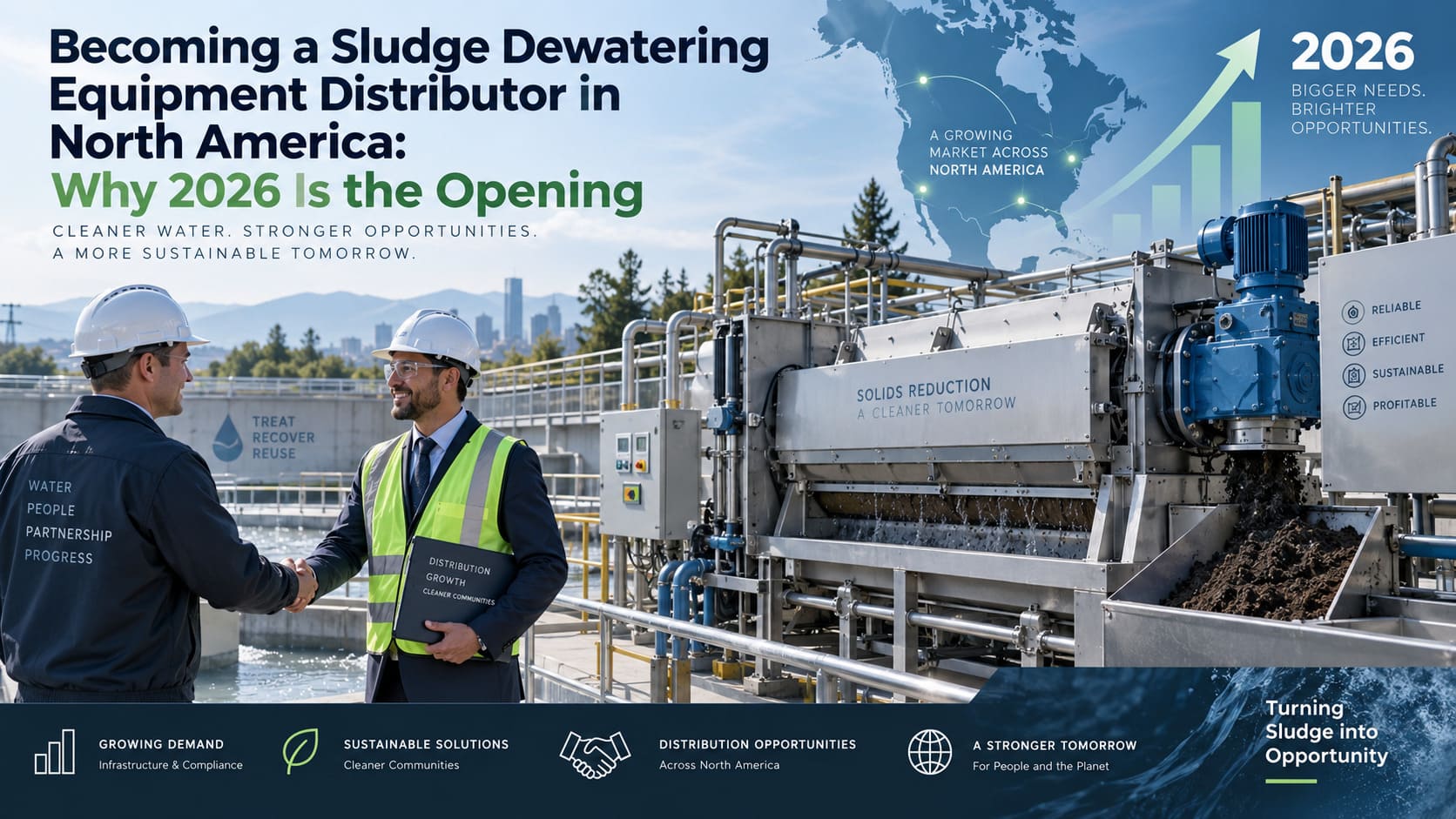
North America is in the middle of the largest structural change to sludge management in forty years. For decades, the cheapest way to get rid of municipal and industrial sludge in the United States was to spread it on farmland. That route is closing, state by state, and the alternatives — landfill and incineration — charge by weight and by volume.
When disposal is priced by the ton, water becomes the expensive part of sludge. That single shift is what makes mechanical dewatering equipment a growth category in North America right now, and it is why GreenCarry Technology is actively appointing regional distributors across the United States and Canada.
This article sets out what is driving demand, which customer segments are buying, how the distributor economics work, what GreenCarry provides, and what we expect from a partner. It is written for water treatment equipment dealers, environmental engineering firms, industrial service companies and EPC contractors who already sell into wastewater accounts and are evaluating whether to add a dewatering line.
Why the North American market is moving now
PFAS has broken the land application model
Land application of biosolids has been the economic floor of the U.S. sludge market. PFAS has removed that floor.
The U.S. EPA released a draft risk assessment for PFOA and PFOS in sewage sludge on 14 January 2025, and followed it on 1 July 2026 with draft guidance for reducing risk from PFOA and PFOS in biosolids, with a public comment period running through 5 October 2026 (U.S. EPA). EPA has also signalled a National Sewage Sludge Survey to generate current national concentration data.
Federal guidance is only part of the pressure. States have moved faster than the federal process. Maine banned land application outright, and the question has since rippled into legislative sessions across the Mid-Atlantic, Midwest and Great Plains. For a utility or an industrial generator, the practical effect is the same whether or not their state has acted yet: land application is no longer a route you can build a twenty-year disposal strategy around.
What replaces it is landfill or incineration. Both charge by mass and volume. Both make the water content of sludge a direct, recurring line item on the operating budget.
Disposal is now a volume problem, and volume is a dewatering problem
A sludge at 3% solids is 97% water. Every ton hauled to a landfill is roughly 30 pounds of actual solids and 1,940 pounds of water that the generator is paying to transport and to tip.
This is the arithmetic that sells dewatering equipment, and it is why the conversation with a North American buyer in 2026 is materially easier than it was in 2020. The buyer does not need to be persuaded that sludge volume matters. They have already seen the invoice.
A second vertical: oil and gas produced water
Alongside municipal and industrial wastewater, North America has a large and distinct sludge stream that most equipment distributors under-serve: the DAF float and oily sludge generated by produced water treatment in shale basins.
Operators in the Permian, DJ, Bakken and Marcellus plays run dissolved air flotation to strip iron, formation fines, carbonate and oil-coated solids out of produced and flowback water. The DAF unit concentrates the contaminants; something still has to take the water back out of the resulting float. A facility handling 100,000 bwpd of produced water at a 0.25% float yield generates roughly 250 barrels — about 1,400 cubic feet — of sludge per day that currently moves to disposal at full liquid volume.
This is a technically distinct sales motion with a different buyer (oilfield water service companies, DAF manufacturers, EPC integrators) and a different sales cycle, and it is largely uncontested by the incumbent municipal equipment vendors. For a distributor with existing energy sector relationships, it is a second addressable market attached to the same product line.
The regulatory position of oilfield sludge
Distributors selling into this segment should understand one regulatory nuance. Many oil and gas exploration and production wastes are exempt from hazardous waste regulation under RCRA Subtitle C, but the exemption does not remove oversight — these wastes remain subject to RCRA Subtitle D and to state regulation, which varies considerably in scope (U.S. EPA).
There is also a TENORM dimension. Radium and its decay products concentrate in produced water solids and treatment sludges, and dewatering concentrates whatever radioactivity is present into the cake. In Colorado, for instance, material below 5 pCi/g is exempt, 5–25 pCi/g is subject to registration, and above 25 pCi/g requires specific licensing (CDPHE). Other states set their own thresholds.
A distributor who can discuss this credibly is a consultant, not a box mover — and prices accordingly.
Which North American customers buy this equipment
The addressable base is broader than municipal wastewater. In practice, the fastest-closing accounts are mid-sized industrial generators who are too small for a centrifuge programme and too large to keep paying liquid haul-off rates.
Food and beverage processing — dairy, meat and poultry, bakery, beverage bottling and prepared foods all run DAF units on their pretreatment, and all produce a high-water float. This is typically the single largest industrial vertical by account count. See food and beverage processing applications.
Livestock and agricultural operations — concentrated feeding operations, particularly in states tightening nutrient management rules. See livestock industry applications.
Breweries and distilleries — a fast-growing, capital-constrained segment where trade waste surcharges bite early. See distillery and brewery waste recovery.
Metal finishing, electroplating and industrial pretreatment — hydroxide sludges under categorical pretreatment standards, where the generator is already dewatering by filter press and is looking at labour cost.
DAF and aerobic digestion sludge across all sectors — the common denominator. See DAF sludge and aerobic digestion sludge.
Oil and gas produced water treatment — as described above, a separate motion with its own buyer set.
The pattern across all of these: the customer already has a flotation or biological process that concentrates contaminants into a sludge. What they lack is an economical way to take the water out of it.
What you would be selling
GreenCarry Technology Co., Ltd. is the exclusive international agent for a Taiwan-built sludge dewatering equipment line. The core product is the Wave Separator, a continuous mechanical solid-liquid separator.
The working principle is a stack of slowly rotating wave-profile discs on a central axis. The discs push slurry toward the separation surface; liquid passes out through wedge-shaped filter gaps while solids are progressively compressed and conveyed forward as cake. The moving disc surfaces clear the filter gaps during operation, which is the design response to the blinding problem that oily and scale-forming solids cause on fixed-media equipment.
Two models are available:
| GC-500 | GC-800 | |
| Feed rate | 200–300 kg/hr (440–660 lb/hr) | 400–600 kg/hr (880–1,320 lb/hr) |
| Cake output | 40–60 kg/hr (88–132 lb/hr) | 80–120 kg/hr (176–265 lb/hr) |
| Suitable feed solids | 2–7% | 2–7% |
| Motor | 2 HP | 2 HP |
| Power supply | 220 / 380 / 440 V, 3-phase, 50/60 Hz | 220 / 380 / 440 V, 3-phase, 50/60 Hz |
| Footprint | 76 × 30 × 83 in | 91 × 43 × 83 in |
| Dry weight | 1,257 lb | 1,676 lb |
Full specifications are on the Wave Separator sludge dewatering machine product page.
The three arguments that close a North American deal
Power draw. Both models run on a 2 HP motor. Against a decanter centrifuge in the same duty class, that is a decisive operating-cost difference, and it is an argument that survives the CFO review because it is a line item, not a projection.
Maintenance profile. Low rotational speed means no high-speed bearing programme, no balancing, no scroll wear replacement cycle. For a food plant with a two-person maintenance department or a remote industrial site, this frequently matters more than capital cost.
Units scale in parallel, not in size. Larger duties are met by installing multiple units rather than specifying a single large frame. This lets a distributor land a small first unit as a proof of concept and expand the same account later — a materially easier first sale than a single large capital item, and a natural path to repeat revenue from an existing customer.
Honest scope. The equipment suits feed in the 2–7% solids range, chemically conditioned with established floc structure. It is not the right answer for grit-laden streams with abrasive coarse sand that has not been removed upstream, for unconditioned sludge with no floc structure, or for free-oil-dominant streams better handled by skimming. Saying so early is what builds a referenceable account base rather than a warranty backlog.
The distributor economics
A distributor's return on this line comes from four streams, not one.
Equipment margin. The primary stream, on unit sales into industrial and municipal accounts.
Multi-unit and expansion sales. Because capacity scales by adding units, an account that starts with one machine is a live opportunity for the next three. Expansion sales into a proven installation carry a far lower cost of sale than the original.
Installation, commissioning and polymer programme. The dewatering result depends on conditioning chemistry. A distributor who owns the polymer programme owns a recurring consumable relationship and the technical relationship that goes with it.
Service and spares. Ongoing maintenance contracts and parts supply across an installed base.
The structurally attractive feature of this product for a distributor is the entry ticket size. A single GC-500 is a capital purchase a plant manager can often approve without a board-level appropriation. That shortens the sales cycle relative to large centrifuge or belt press programmes and lets a new distributor build an installed base and reference list quickly, before pursuing larger multi-unit projects.
Where the payback argument comes from
Based on the equipment's published input and output ratings, the mass of material leaving the site falls by roughly 75–80%, with separated filtrate returned to the front of the treatment process.
The distributor's job is to run that reduction against the customer's own current haul-off and tipping invoices. Those rates vary widely by state, waste classification and hauler contract, so the credible sales approach is to build the payback from the customer's actual numbers rather than from a generic figure. In most industrial accounts, the disposal line item is already well documented — the customer can produce it in a meeting.
What GreenCarry provides to distributors
GreenCarry supplies international markets directly and through regional partners. Partner support covers:
- Technical training on equipment operation, sizing, polymer conditioning and troubleshooting
- Application engineering support for sizing and quotation on live opportunities, including unit count, footprint and power requirements from customer sludge data
- After-sales support and spare parts supply
- Marketing and technical materials in English for use with your customers
- Territory arrangements discussed case by case, based on coverage capability and market plan
Full details of the partnership are on the global partnership opportunities page.
One item to settle early: electrical listing
The equipment is supplied to CE requirements. United States installations typically require NRTL listing (UL or CSA) or field evaluation by an NRTL, and equipment placed in a classified area — which is common at oil and gas sites — must be specified for that classification.
This is not an obstacle so much as a scoping item, and it is one reason the North American market needs a local partner rather than direct export. A distributor who understands the listing and inspection path in their states, and who raises it at the quoting stage rather than at commissioning, removes the single most common cause of delay on imported equipment projects. Bring the requirement to us when you quote and the correct build is scoped from the start.
Who this partnership suits
A good fit:
- Water and wastewater treatment equipment dealers with an existing industrial account base
- Environmental engineering and consulting firms that specify equipment and want a supply relationship
- Industrial service companies already handling sludge hauling, dewatering rentals or plant services
- EPC contractors and system integrators building treatment packages where sludge volume reduction is part of the design basis
- Oilfield water service companies looking to add dewatering to an existing produced water scope
Not a fit:
- Pure trading companies without technical capability — this product requires application engineering at the quotation stage and support after commissioning
- Distributors expecting a drop-ship relationship with no local service capability
- Partners unwilling to develop polymer conditioning expertise, which is where most field performance problems originate
We would rather have a smaller number of technically capable partners with strong reference installations than broad coverage with weak support. Reference accounts are how this product category grows.
How to start a conversation
The first discussion is usually short and practical. We will want to understand:
- Your current customer base and the industries you already sell into
- The territory you can realistically cover with service, not just sales
- Your technical and after-sales capability
- Whether you have live opportunities that could serve as a first installation
We will provide equipment specifications, sizing support on those opportunities, commercial terms and lead times.
Frequently asked questions
Is GreenCarry the manufacturer? No. GreenCarry Technology Co., Ltd. is the exclusive international agent for a Taiwan-built sludge dewatering equipment line. Domestic Taiwan sales are handled separately by the manufacturing partner.
Is the equipment UL listed for the United States? It is supplied to CE requirements. U.S. NRTL listing (UL or CSA) or field evaluation, and any hazardous-area classification requirement, should be specified at the quoting stage so the correct build is scoped. Distributors should confirm the requirement with the authority having jurisdiction for each installation.
What size accounts does this product suit? Mid-sized industrial generators are the core market — accounts producing sludge in the range a GC-500 or GC-800 handles, or multiples of those units. Very large municipal plants are typically centrifuge accounts; very small generators may not yet have a disposal cost that justifies capital equipment.
Do distributors get exclusive territory? Territory arrangements are discussed case by case based on your coverage capability and market plan. Contact us to discuss your proposed territory.
Can we sell into oil and gas produced water applications? Yes, and it is an under-served segment in North America. Note that the equipment dewaters the DAF sludge produced by produced water treatment — it does not treat the produced water stream itself. That distinction needs to be clear in every conversation with an energy sector buyer.
What support is available during the sales process? Application engineering support for sizing and quotation on live opportunities. Send the sludge data — flow rate, solids percentage, polymer programme — and we return a unit count, footprint, power requirement and lead time.
How quickly can a new distributor get to a first installation? That depends on your pipeline. The advantage of a single-unit entry ticket is that a first installation does not require a large capital appropriation from the end customer, which shortens the cycle relative to large dewatering programmes.
Discuss a North American distributorship
If you sell into industrial or municipal wastewater accounts in the United States or Canada and want to add a dewatering line with a defensible operating-cost argument, we would like to talk.
Tell us your territory, your current customer base and your service capability, and we will come back with equipment details, commercial terms and support on any live opportunities you are already working.
Apply to become a GreenCarry partner · Contact us directly · info@greencarrytech.com
Related reading: Distributing sludge dewatering equipment in Europe under the new Urban Wastewater Treatment Directive · Sludge dewatering distribution in Malaysia: palm oil, scheduled waste and the 20-tonne problem · Becoming an Australian distributor: EESS, waste levies and the responsible supplier role · Wave Separator sludge dewatering machine