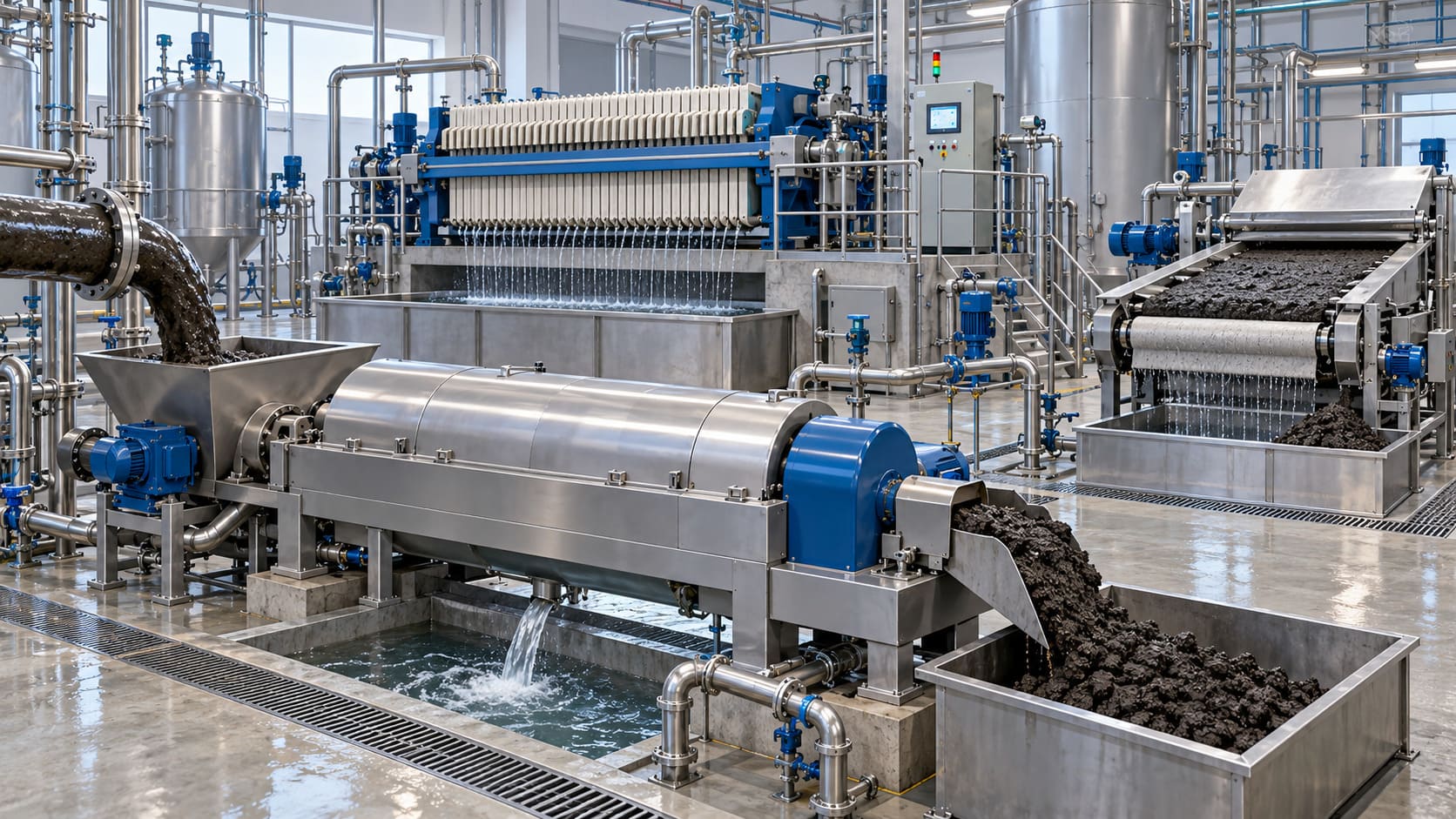
Chemical and pharmaceutical plants generate some of the most challenging sludge streams in industrial wastewater treatment. The effluent arriving at a dewatering machine may carry residual solvents, active pharmaceutical ingredients (APIs), synthetic dyes, or catalyst-laden precipitates — each capable of fouling conventional equipment, triggering hazardous waste classifications, or failing pretreatment limits before a single ton of cake leaves the gate.
This guide is written for environmental engineers, plant utilities managers, and procurement leads who are evaluating sludge dewatering equipment options for chemical synthesis, pharmaceutical manufacturing, specialty chemical, or fine chemical operations. It covers the specific wastewater sources and sludge types these facilities produce, the regulatory framework governing disposal, equipment selection criteria for the downstream dewatering step, and where a slowly rotating wave-disc press fits — and where it does not.
Why Chemical and Pharmaceutical Sludge Is Different
In food processing or livestock wastewater, sludge is predominantly organic and relatively homogeneous. Chemical and pharmaceutical sludge is anything but. Even within a single facility, the composition of sludge pulled from a clarifier or dissolved air flotation (DAF) unit can vary hour to hour as production campaigns change.
Multiple Sludge Sources Under One Roof
A typical chemical or pharmaceutical plant generates sludge from at least three distinct treatment stages:
Primary clarification or DAF. Raw process wastewater passes through a DAF unit or settling clarifier to remove suspended solids — precipitated metal hydroxides, catalyst fines, unreacted raw materials, and biological floc. The float or settled material that exits at this stage is usually 2–6% dry solids, highly variable in composition, and strongly influenced by upstream chemical conditioning (coagulant and flocculant type and dose).
Biological treatment residuals. Facilities with on-site biological treatment (activated sludge, sequencing batch reactor) generate waste activated sludge (WAS). Pharmaceutical fermentation plants in particular produce WAS with high organic loads from fermentation broths, antibiotic intermediates, or API synthesis residues. This sludge is typically 0.5–2% dry solids before thickening.
Chemical precipitation sludge. Heavy metals, phosphates, and certain organics are removed by chemical precipitation — lime, ferric sulfate, aluminum sulfate. The resulting sludge can carry F-listed hazardous waste codes under RCRA if it derives from specific listed processes, and its handling is governed by 40 CFR Parts 262–266.
Understanding which of these streams is being dewatered — or whether all three are being combined into a mixed sludge — is the single most important pre-selection step before evaluating any dewatering machine.
The Regulatory Landscape: What You Must Know Before Specifying Equipment
Clean Water Act: Effluent Guidelines for Pharmaceutical and Chemical Facilities
The EPA's effluent limitations guidelines for pharmaceutical manufacturing are codified at 40 CFR Part 439, covering five subcategories: fermentation products, extraction products, chemical synthesis products, mixing/compounding and formulation, and research. These guidelines govern both direct dischargers (NPDES permits) and indirect dischargers (pretreatment standards under 40 CFR Part 403 for facilities sending to a publicly owned treatment works).
For organic chemical manufacturers, the applicable regulation is 40 CFR Part 414, the Organic Chemicals, Plastics and Synthetic Fibers (OCPSF) effluent guidelines. Specialty chemical and fine chemical operations may also fall under Part 414 or sector-specific pretreatment standards depending on their NAICS classification.
These effluent guidelines establish limits on BOD₅, COD, total suspended solids (TSS), oil and grease, pH, and specific priority pollutants. The sludge generated during compliance with these limits — particularly from chemical precipitation — inherits its regulatory status from the wastewater it treated.
RCRA: When Sludge Becomes Hazardous Waste
Sludge disposal crosses into federal hazardous waste territory under the Resource Conservation and Recovery Act (RCRA), administered under 40 CFR Parts 260–266. This is the regulatory layer that most significantly affects equipment selection and operating cost for chemical and pharmaceutical facilities.
Several RCRA-listed waste codes are directly relevant:
- F006: Wastewater treatment sludge from electroplating operations (also appears in chemical finishing). If your facility performs chemical conversion coating of metal parts, your clarifier sludge may carry F006 status.
- F019: Wastewater treatment sludge from the chemical conversion coating of aluminum.
- K-codes: Specific listed hazardous wastes from individual industrial processes. Chemical synthesis operations may generate K-listed sludges if the source wastewater falls under a listed process category.
For pharmaceutical facilities, the RCRA concern shifts from metal-heavy K/F codes to characteristic hazardous waste — particularly ignitability (D001), toxicity characteristic (D018 for benzene, D039 for tetrachloroethylene), or reactivity (D003) depending on the API or solvent in use.
The critical implication for dewatering: A higher-solids cake occupies significantly less volume than a wet sludge. Since hazardous waste disposal is typically charged by volume or weight at licensed treatment, storage, and disposal facilities (TSDFs), every percentage point of additional cake dryness translates directly into reduced disposal cost. The difference between a 15% and a 25% dry-solids cake can cut disposal tonnage by 40% or more.
NPDES and Pretreatment: The Upstream Driver
Most chemical and pharmaceutical facilities discharge to a POTW under a local pretreatment permit tied to 40 CFR Part 403. TSS and oil-and-grease limits in these permits create direct pressure to maintain effective dewatering upstream: if the centrate or filtrate returning from the dewatering stage has high TSS (due to poor solids capture), it worsens the facility's pretreatment compliance position. Solids capture rate is therefore not just an equipment performance metric — it is a compliance metric.
Dewatering Technology Comparison for Chemical and Pharmaceutical Sludge
For this sector, five main technologies compete: belt filter presses, decanter centrifuges, filter presses (plate-and-frame), screw presses, and wave-disc presses. Each has a different performance profile against the characteristics common in chemical and pharma sludge.
Belt Filter Presses
Belt presses can dewater DAF sludge reliably when the sludge responds well to polymer conditioning. Cake dryness typically reaches 18–25% DS. The major liabilities in a chemical or pharmaceutical context are high wash-water consumption (the belts require continuous rinsing), odor generation from open-deck operation, and sensitivity to variations in sludge composition. When production campaigns change and sludge characteristics shift, belt press performance can degrade noticeably without operator intervention.
Decanter Centrifuges
Centrifuges can handle variable sludge feeds and achieve 20–28% DS. They are the standard choice for pharmaceutical fermentation plants where sludge volume is high and fine biological solids predominate. The disadvantages are high energy consumption, significant noise, vibration, and maintenance demands from high-speed mechanical components, and sensitivity to abrasive particles — a concern in certain inorganic chemical sludges containing catalyst fines or precipitated silica.
Plate-and-Frame Filter Presses
Filter presses achieve the highest cake dryness of any mechanical technology — 30–40%+ DS — and are widely used for chemical precipitation sludge where maximum volume reduction before hazardous waste disposal is the priority. The disadvantage is batch operation, higher operator involvement, and press cloth maintenance. For facilities that generate sludge continuously rather than batch-by-batch, filter presses require holding tanks and a more active operational role.
Screw Presses and Wave-Disc Presses
Both screw presses and wave-disc presses (such as the Wave Separator from GreenCarry Technology) operate continuously and at low speed, which makes them quiet, low-maintenance, and self-cleaning — attractive features in a chemical or pharmaceutical plant where operator time is expensive and enclosed operation is preferred to control odors and vapor exposure.
The Wave Separator uses slowly rotating wave-profile discs with wedge-shaped filter gaps. This geometry means the machine does not apply high compressive force in a single zone, but instead progressively dewaters the sludge as it moves through the disc stack. For DAF sludge at 2–5% DS input from a chemical wastewater treatment system, the Wave Separator targets output of 15–25% DS depending on sludge composition and polymer conditioning — a volume reduction of roughly 4:1 to 6:1 compared to the incoming DAF float.
For a deeper discussion of how to select among these technologies based on sludge characteristics, see our sludge dewatering machine selection guide.
Where the Wave Separator Fits — and Where It Does Not
Being honest about application boundaries is more useful than a general-purpose sales claim. Here is a frank assessment:
Well-Suited Applications in Chemical and Pharmaceutical Plants
Pharmaceutical wastewater DAF sludge — particularly from formulation, compounding, and extraction operations where the sludge is predominantly biological and organic. The low-shear operation of the Wave Separator preserves floc structure and does not generate aerosol from high-speed rotation, which matters when handling API-containing sludge.
Specialty chemical plant biological treatment residuals — waste activated sludge from aerobic biological treatment at fine chemical or polymer plants, where continuous unattended operation at low energy consumption is prioritized.
Combined DAF and biological sludge in plants where both streams are blended before dewatering, and the total input solids are in the range the machine handles effectively.
The Wave Separator is available in two models suited to different throughput needs. The GC-500 handles 200–300 kg/hr of input sludge (about 440–660 lb/hr) and produces 40–60 kg/hr of dewatered cake. The GC-800 handles 400–600 kg/hr of input (880–1,320 lb/hr) with 80–120 kg/hr of cake output. Both run on 2 HP, operate on 220/380/440V three-phase power at 50 or 60 Hz, and are CE certified with a one-year warranty. Full specifications are on the Wave Separator product page.
Not Recommended
Heavy metal precipitation sludge — calcium, iron, or aluminum hydroxide sludge from chemical precipitation typically has poor filterability characteristics. High inorganic content sludge with abrasive particles can increase disc wear. Filter presses or centrifuges are more appropriate here.
RCRA-listed sludge with high solvent or volatile organic compound (VOC) content — enclosed operation helps limit vapor exposure, but the Wave Separator is not designed as a solvent-recovery or VOC-capture system. Such sludge may require a sealed, explosion-proof-rated system with vapor collection, which falls outside this equipment's specification.
Very high-throughput facilities generating thousands of tons per day of hazardous sludge — the Wave Separator is sized for small-to-medium chemical and pharmaceutical plants or for pilot-scale dewatering lines within larger facilities.
Total Cost of Dewatering: The Disposal Math
One calculation that rarely appears in equipment brochures is the direct cost reduction from higher cake dryness at the dewatering stage. In the U.S., non-hazardous industrial sludge landfill tipping fees have risen substantially — recent data indicates national averages around $62/ton for non-hazardous industrial waste as of 2024, with hazardous waste TSDF disposal running several times higher depending on waste code and disposal method.
Consider a chemical plant generating 100 gallons per minute (GPM) of process wastewater with a DAF sludge output of approximately 50 wet tons per month at 4% DS (roughly 2 dry tons of solids per month). If that sludge is hauled at 5% DS (wet weight ~40 tons/month) versus 20% DS (wet weight ~10 tons/month), the disposal tonnage difference is approximately 30 tons per month. At even a conservative $100/ton all-in disposal rate, that is $3,000/month, or $36,000/year, in avoided disposal cost — before factoring in hauler fuel surcharges, TSDF permitting fees, and transportation costs.
For hazardous waste streams where disposal costs are
2,000/ton or higher, the economic case for maximum mechanical dewatering before disposal is even stronger. This is why specifying a dewatering machine on purchase price alone — without lifecycle cost modeling — routinely leads to the wrong equipment decision.
For readers comparing against food processing or livestock dewatering scenarios, the same disposal cost logic appears in our earlier industry guides covering wastewater management in food and beverage operations and livestock and agricultural sludge dewatering.
Procurement Checklist: What Chemical and Pharmaceutical Plants Should Request
Before issuing a request for quotation (RFQ) for a dewatering machine, confirm the following from your operations and EHS team:
Sludge characterization
- Inlet solids concentration (% DS), measured — not estimated
- Sludge source: DAF float, biological WAS, chemical precipitation, or blend
- RCRA status: non-hazardous, characteristic hazardous, or listed waste
- Presence of abrasive inorganic particles, heavy metals, or residual solvents
- Polymer conditioning already in use (coagulant type, dose, mixing point)
Throughput requirements
- Peak and average daily sludge volume (gallons or cubic meters per day)
- Desired cake dryness (%DS) target, driven by disposal route and cost
- Required solids capture rate (% of inlet solids retained in cake)
Installation constraints
- Available floor space and ceiling height
- Electrical service available (voltage, phase, Hz)
- Wash-water availability and drainage capacity
- Enclosure requirements for odor, vapor, or biosafety containment
Regulatory documentation
- Equipment CE marking (for export or multinational compliance)
- Any UL/CSA or NRTL listing requirements for U.S. installations (note: CE alone does not satisfy U.S. national electrical listing requirements; consult your AHJ)
- Material Safety Data Sheet (SDS) requirements for any chemicals in the sludge, relevant to handling and disposal
Frequently Asked Questions
Can the Wave Separator handle sludge that varies significantly between batches, as is common in multi-product pharmaceutical synthesis?
Variable sludge composition is a real challenge in campaign-based pharmaceutical manufacturing. The Wave Separator's slowly rotating disc design is inherently less sensitive to feed variation than high-speed centrifuges or belt presses, because it does not rely on precise cake release timing or belt tracking. However, significant changes in polymer conditioning or feed concentration between batches will still affect output cake dryness. A buffer tank upstream is recommended in campaign-based operations to homogenize the sludge feed before it reaches the dewatering machine.
Our facility discharges to a POTW under a pretreatment permit. Does the centrate (filtrate) from the Wave Separator need to be treated further?
Yes — the centrate or filtrate from any mechanical dewatering machine, including the Wave Separator, is returned to the main wastewater treatment train rather than discharged directly. Its quality depends on solids capture efficiency and should be accounted for in your wastewater treatment system design. For facilities on tight TSS pretreatment limits, target a solids capture rate of ≥95% from the dewatering step.
What does "slowly rotating wave-profile discs with wedge-shaped filter gaps" mean in practical terms?
Rather than a single high-pressure compression point (as in a screw press auger) or high-speed centrifugal force (as in a decanter centrifuge), the Wave Separator's discs rotate at very low RPM. Water is expressed gradually through the wedge-shaped filter gaps between adjacent discs as the sludge cake is conveyed along the disc stack. This low-shear approach reduces energy consumption, minimizes vibration and noise, and avoids the mechanical wear patterns associated with high-force dewatering. The full working principle is described on the product page.
Does GreenCarry Technology manufacture the Wave Separator?
GreenCarry Technology Co., Ltd. is the exclusive international agent for this Taiwan-built equipment line. Our role covers international distribution, distributor partnership, technical sales support, and after-sales coordination. The manufacturing partner handles domestic Taiwan production and domestic sales. This arrangement is important to understand when inquiring about lead time, spare parts sourcing, and regional after-sales support in your territory.
What certifications does the Wave Separator carry?
Both the GC-500 and GC-800 models are CE certified, confirming compliance with applicable EU machinery, electrical, and safety directives. For installations in the United States, Australia, or other markets, buyers should verify local listing or certification requirements with their authority having jurisdiction (AHJ) or procurement team. GreenCarry Technology can provide CE documentation on request.
Ready to Evaluate the Wave Separator for Your Facility?
GreenCarry Technology works with chemical and pharmaceutical plant engineers, environmental compliance managers, and regional distributors to assess sludge dewatering applications. Provide your sludge characterization data — inlet concentration, source, daily volume, and disposal route — and we can advise on model suitability, expected cake dryness, and ROI from reduced disposal tonnage.
Contact us to discuss your application:
greencarrytech.com/en/contact
Email: info@greencarrytech.com
If you are a distributor or agent interested in representing GreenCarry Technology in your market, visit our distributor partnership page for territory details and application information.
GreenCarry Technology Co., Ltd. is the exclusive international agent for the Wave Separator sludge dewatering machine and Spherical Aeration Diffuser, manufactured in Taiwan.